The fastest way to fix a cluttered garage is to stop thinking about products and start thinking about zones. Every garage has four: the floor along the walls, the wall surface above it, the ceiling, and the parking lanes you must keep clear. Heavy things you use often go low and near the door you walk through; long and awkward things go on the wall; light seasonal things go overhead. Measure the car, the door and the walls first, then buy the storage that fits each zone. This guide is spec-based: products are compared on their published listings and manuals, checked on 2026-10-28, not on tests of our own.
Disclosure: As an Amazon Associate I earn from qualifying purchases. Some brands featured below pay a bonus commission through Amazon Creator Connections. See /disclosure/.
Step 1: Measure before you buy anything
Five measurements decide almost every storage choice. Write them down on a sketch of the floor.
Clear wall length on each side and the back, minus doors, windows, the water heater, electrical panel and any outlet you need to reach.
Car-door strip. Park the car where it normally sits, open each door to the point you actually use, and mark the floor. That strip stays empty, so anything along that wall must be shallow.
Hood-to-wall gap. Measure from the bumper to the back wall. If it is under about 3 feet, deep floor shelving there will make you walk sideways.
Ceiling height and garage door travel. Open the door fully and measure from its highest point (door panel, track or opener) to the ceiling. The door and opener need their own headroom: Clopay says a standard 12-inch-radius track needs at least 12 inches above the door. Our guide to overhead rack ceiling height and door clearance walks through the numbers.
Stud spacing and wall type. Wood studs at 16 or 24 inches, concrete block, or finished drywall over steel studs. This decides which wall systems you can use.
Step 2: Sort what you own into four groups
Before shelving, sort. Pull everything into the driveway and group it:
Daily or weekly, heavy: tool bags, bulk pantry overflow, pet food, recycling, the shop vac.
Daily or weekly, light or long: brooms, rakes, shovels, the hose, folding chairs, bikes, scooters.
Seasonal or rare, heavy: spare tiles, bagged concrete, car parts, archive boxes of paper.
The zone plan below maps each group to a place.
The four zones at a glance
Zone
What goes there
Typical depth or reach
What to buy
Main limit
Floor shelving
Heavy and frequently used totes, bulk items
About 24 in for 27-gal totes; 16 to 18 in for small items
Freestanding steel units, anchored
Per-shelf rating and tip-over
Wall (low, 0 to 6 ft)
Long-handled tools, hose, chairs, bikes, hand tools
6 to 20 in off the wall
Rails, slatwall, pegboard, wall shelves
Studs and fasteners
Overhead
Light seasonal totes, bulky gear
12 to 45 in drop, depending on rack
Ceiling racks or tote rails
Joists and door clearance
Parking lanes
Nothing
Car width plus open doors
Floor tape or a wheel stop
Your car’s doors
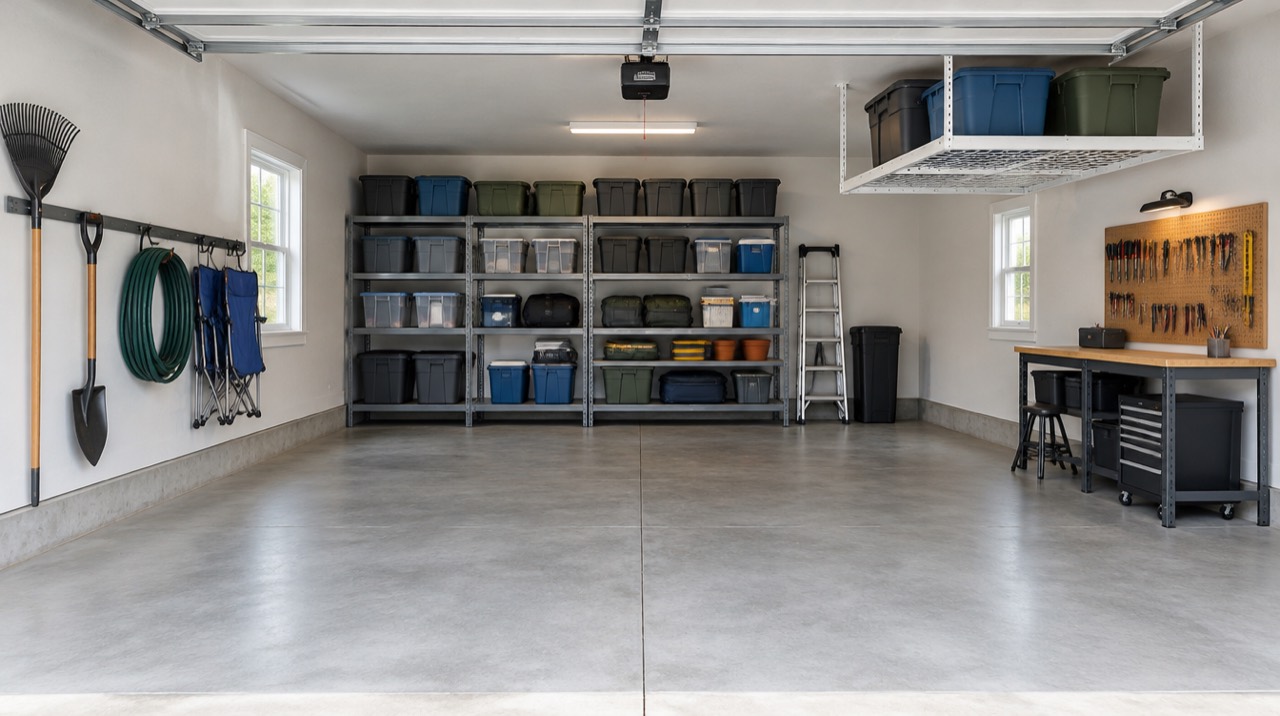
A typical zone layout: deep shelving on the back wall, wall storage on the sides, overhead racks above the hoods, and clear lanes for cars and doors.
Zone 1: Floor shelving for heavy, frequent things
Freestanding steel shelving carries the heaviest loads because the weight goes straight down the posts to the slab. Put it where you can reach it without moving the car: usually the back wall in front of the hood, or a side wall beyond the car doors.
Depth. A Sterilite 27-gallon tote measures 28 1/2 x 19 5/8 x 15 1/2 inches. On a 24-inch-deep shelf it sits with the long side along the shelf. On a 48-inch-wide shelf that is one tote per tier with room for a smaller bin beside it; a second 27-gallon tote turned sideways would overhang a 24-inch shelf by about 4 inches (our arithmetic). Our guide to garage shelving depth for totes covers every common tote size.
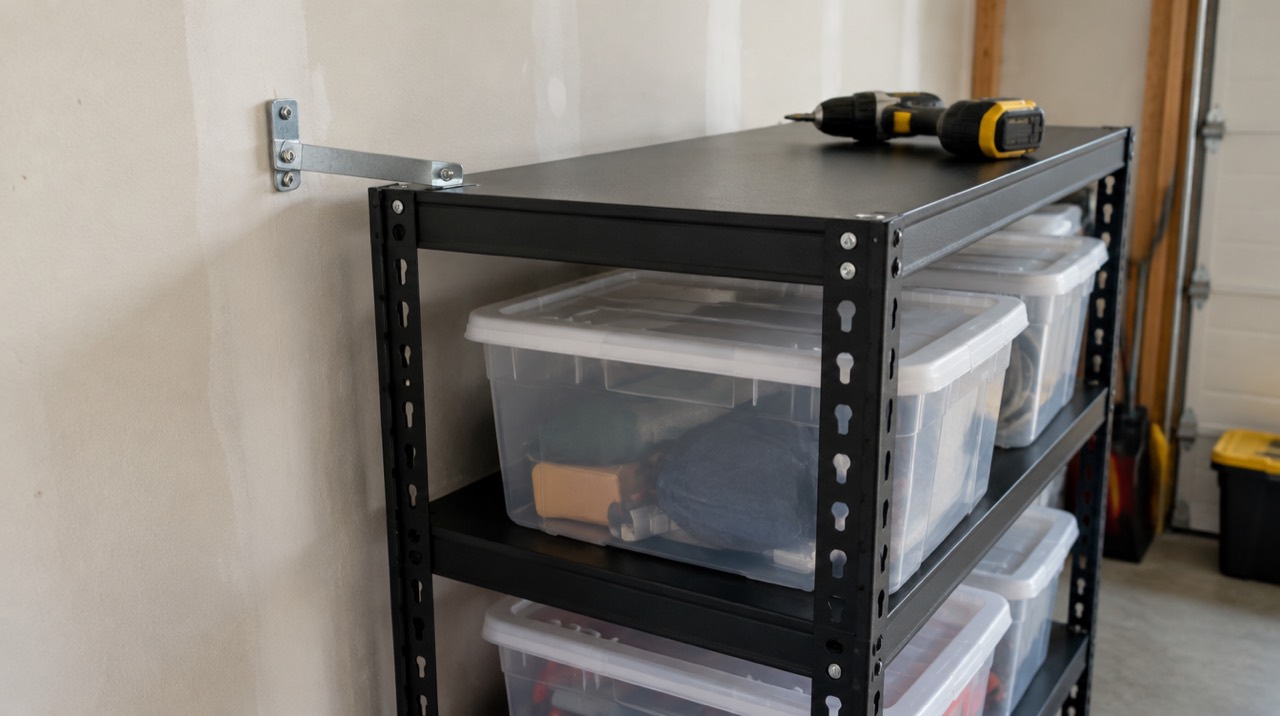
Rating. Read the per-shelf number, not the total. Heavy totes go on the bottom two shelves, as shelving manuals such as Edsal’s instruct, and every tall unit should be anchored to the wall. The CPSC’s Anchor It campaign says to anchor all furniture with shelves, and our anchoring guide shows how on wood studs and block walls.
Featured (disclosed relationship)
REIBII 48.2 x 24.5 x 72 in 5-tier shelving. Listed at 602 lb per shelf (REIBII says "tested by third-party labs" without naming the lab) and 3,010 lb total, and its listing says it holds five 27-gallon totes, which on our arithmetic is one per tier. It splits into two shorter racks. It suits a back wall in front of the hood. What it is not: a unit for a wall where car doors swing, because at 24.5 inches deep it takes real floor. The Amazon link follows below this box.
$175.98Price as of November 18, 2026, 4:08 PM ET. Prices and availability are accurate as of the date/time indicated and are subject to change. Any price and availability information displayed on Amazon.com at the time of purchase will apply to the purchase of this product.
Featured (disclosed relationship)
Lionhon heavy-duty 4-tier, 59 x 23 x 67 in. Listed at 4,500 lb total and up to 1,125 lb per shelf when evenly distributed, with one-piece steel shelf panels, anti-drop safety pins and foot pads. The wider, lower shape suits a back wall under a window and takes two 27-gallon totes per shelf long side forward. What it is not: a five-tier unit, or a deep one; at 23 inches a 27-gallon tote fits with little margin. The Amazon link follows below this box.
$125.99Price as of November 18, 2026, 4:08 PM ET. Prices and availability are accurate as of the date/time indicated and are subject to change. Any price and availability information displayed on Amazon.com at the time of purchase will apply to the purchase of this product.
For a long run of wall, the REIBII 68.3-inch 4-tier wire rack ($169.99) (Featured, disclosed relationship) is listed at 1,272 lb per shelf and comes with two anti-tip kits. It is not for a narrow wall: it needs nearly 6 feet of clear width.
Price as of November 18, 2026, 4:08 PM ET. Prices and availability are accurate as of the date/time indicated and are subject to change. Any price and availability information displayed on Amazon.com at the time of purchase will apply to the purchase of this product.
All three are compared fairly against other units, including Edsal and Husky, in our best garage shelving roundup. Check the current price on Amazon before you choose, and buy to the per-shelf rating you need rather than the biggest total.
Zone 2: The wall, for long and frequently grabbed items
The wall above the floor shelving and along the car side is where rakes, shovels, hoses, chairs, ladders and bikes belong. Keep anything that sticks out more than a few inches above head height or behind the car-door strip.
There are three wall systems and a fourth option:
Track rails (Rubbermaid FastTrack, Gladiator GearTrack): a horizontal rail with hooks that slide or move. Best for long-handled tools and chairs. Rubbermaid’s install sheet suggests rail heights of 7 ft 3 in and 4 ft.
Slatwall (Gladiator GearWall, Proslat): full panels that take hooks, baskets and shelves anywhere. Gladiator rates GearWall at 50 lb per square foot.
Pegboard (hardboard or steel, such as Wall Control): small hand tools above a workbench.
Wall shelves: bracket shelves screwed into studs, for paint, sprays and small bins.
For shallow shelves on the car side, the FOFARY 1.64 x 4 ft wall shelving 2-pack ($129.99) (Featured, disclosed relationship) is listed at 48 x 20 inches per shelf and mounts to wood studs, concrete or brick. Its listing gives 300 lb without saying whether that is per shelf or per pair, so plan on 150 lb per shelf. Not for a car-door wall where 20 inches is too deep; for that, its 24 x 12-inch 2-pack ($39.99) is shallower, though the listing contradicts itself on capacity (100, 200 and 300 lb in different places), so plan on the lowest. Our wall-mounted garage shelves guide covers studs and brackets.
Price as of November 18, 2026, 4:08 PM ET. Prices and availability are accurate as of the date/time indicated and are subject to change. Any price and availability information displayed on Amazon.com at the time of purchase will apply to the purchase of this product.
Zone 3: Overhead, for light seasonal things
Overhead racks turn the dead space above the hoods into storage for things you touch a few times a year. They are the wrong place for heavy or frequently used items: every trip means a ladder.
Three rules decide where a rack can go:
Not in the door’s path. Open the door fully and check the panel, track and opener. FLEXIMOUNTS says to leave at least 22.5 inches between the door and ceiling to mount its rack above a door.
Into joists. SafeRacks’ manual requires at least 2x6 wood joists at 24 inches on center or less, with at least 2 inches of lag penetration, and calls the house frame the weakest point of the system.
Clear of the vehicles. Measure the tallest vehicle and any open hatch or hood, and set the drop so the deck clears it.
SafeRacks sells drops from 12 to 24 inches up to 24 to 45 inches, so most ceilings have an option. A 4 x 8 ft deck holds six 27-gallon totes in one layer (our arithmetic: 3 x 28.5 in by 2 x 19.6 in). Sizing, joists and capacity are covered in overhead garage storage, and installation in how to install an overhead garage rack.
Zone 4: The parking lanes stay empty
The lanes are a zone too, and the easiest one to lose. A few habits keep them clear:
Mark the car-door strip and the walking path with floor tape after you measure.
Use a wheel stop or a hanging ball so the car parks in the same spot every time; otherwise the shelving depth you planned stops working.
Keep rolling storage to one corner. The REIBII rolling 4-tier unit ($79.99) (Featured, disclosed relationship) is listed at 530 lb on its casters and 2,080 lb on its fixed feet, so on wheels it is a cart for light gear, not heavy totes.
Price as of November 18, 2026, 4:08 PM ET. Prices and availability are accurate as of the date/time indicated and are subject to change. Any price and availability information displayed on Amazon.com at the time of purchase will apply to the purchase of this product.
Special items that need their own spot
Fuel, solvents and paint thinner: away from the water heater, furnace and any spark source, in approved containers, following the container label and your local fire code. A dedicated cabinet is covered in our planned flammable storage cabinet guide.
Buying shelving before measuring the car doors. A 24-inch unit on the wrong wall means you squeeze out of the car every day.
Putting heavy things overhead. If you would not want to carry it up a ladder, it belongs on the floor.
Skipping the anchor. Tall loaded shelving tips. Anchor into studs or masonry.
Racks in the door’s travel. Measure with the door fully open.
Mixing wall systems at random. Hooks for one rail system generally do not fit another, so pick one system per wall.
Start with one anchored steel unit and one wall rail, live with them for a month, then add overhead storage for whatever is still on the floor.
Frequently asked questions
What is the best way to organize a garage?
Sort what you own by how often you use it and how heavy it is, then give each group a zone. Heavy and frequently used items go on floor shelving or low wall hooks near the door you walk through. Long-handled tools, chairs and bikes go on wall rails. Light, seasonal items go overhead. Keep the parking lanes and the garage door's path completely clear.
How deep should garage shelving be?
About 24 inches deep if you store 27-gallon totes, because a Sterilite 27-gallon tote is 19 5/8 inches deep at the rim and needs a little room to slide. Shallower 16 to 18-inch shelving suits paint cans, sprays and small bins and leaves more room to walk past a parked car.
What should go on an overhead garage rack?
Light, bulky things you need a few times a year: holiday decorations, camping gear, coolers, spare bedding, off-season sports gear. Heavy or dense items such as books, tile or tools belong on floor shelving. Overhead racks are rated for static, evenly spread loads, and your ceiling joists, not the rack, usually set the real limit.
Where should shelving go in a garage?
Along the back wall in front of the hood, or along a side wall where it will not block car doors. Measure how far your car doors open and keep that strip free. Anchor any tall freestanding unit to the wall, as the CPSC's Anchor It campaign recommends for furniture with shelves.
How do I plan garage storage on a budget?
Start with one anchored freestanding steel unit for heavy totes and one wall rail for long tools, which clears most floors. Add an overhead rack only after you know what is left. Measure first so you do not buy shelving that blocks a car door or a rack that hits the open garage door.
Free garage storage tools
Tote and Shelf Fit CalculatorPick your storage tote and shelf size to see how many fit per shelf, which way to face them, the overhang and how many units you need.
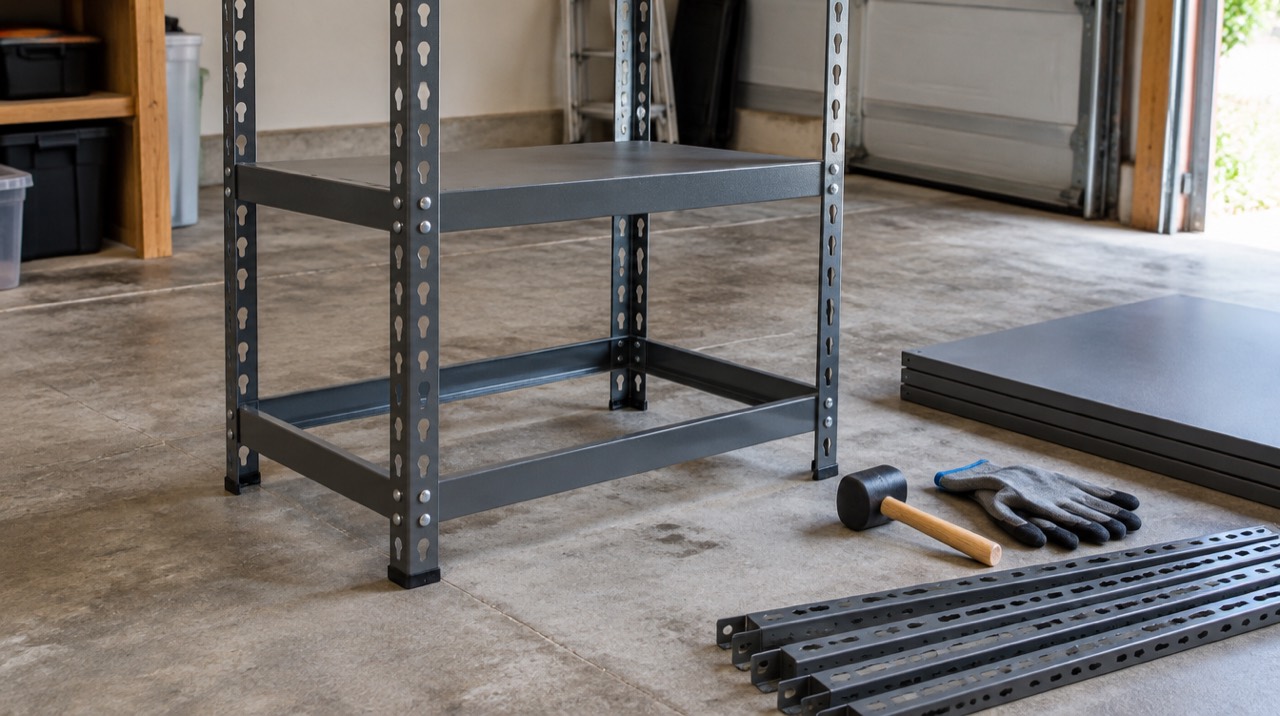
How to assemble boltless rivet shelving the way the manuals say: keyholes narrow end down, beams ledge-up, seat every rivet, level, anchor, avoid mistakes.
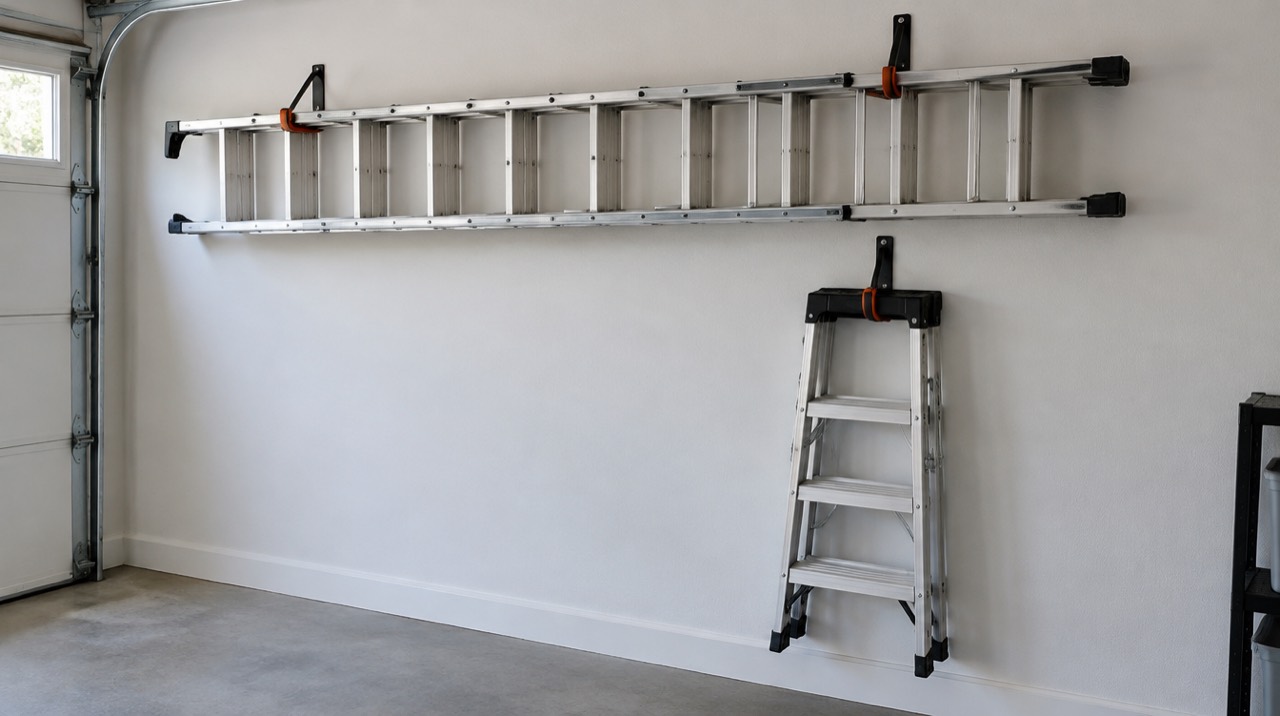
Garage ladder storage compared: wall hooks for frequent use, ceiling racks for rare use, pulley hoists for high ceilings, with weights, ratings and mounting.