Slatwall vs Pegboard vs Track Rails for Garage Walls
In this guide
Pick the garage wall system by what you are hanging. Track rails are the best value for long-handled tools, chairs, ladders and bikes along a wall. Slatwall is the best choice when you want a whole wall that takes hooks, baskets and shelves anywhere and publishes a per-square-foot rating. Pegboard, especially steel pegboard, is for small hand tools over a workbench. All three only carry their rated loads when they are fastened into studs or masonry, and none of them shares hooks with the others. This is a spec-based comparison: ratings come from manufacturer pages, install sheets and listings checked on 2026-10-28, not from tests of our own.
Disclosure: As an Amazon Associate I earn from qualifying purchases. Some brands featured below pay a bonus commission through Amazon Creator Connections. See /disclosure/.
The short answer by job
| Job | Best fit | Why |
|---|---|---|
| Rakes, shovels, brooms, hose | Track rail | Cheap per hook, long hooks, rail spans studs |
| Folding chairs, ladder, bikes | Track rail or slatwall | Heavy-duty hooks rated 25 to 50 lb |
| Whole wall, mixed gear, baskets and shelves | Slatwall | Hooks go anywhere on the panel; published per-sq-ft rating |
| Hand tools over a workbench | Pegboard (steel for heavier tools) | Small hooks, outlines, cheap |
| Paint, sprays, small bins | Wall shelves or slatwall shelves | Flat surface beats hooks |
| Renters who cannot drill | None of these | All need screws into studs; see freestanding options |
What each system is
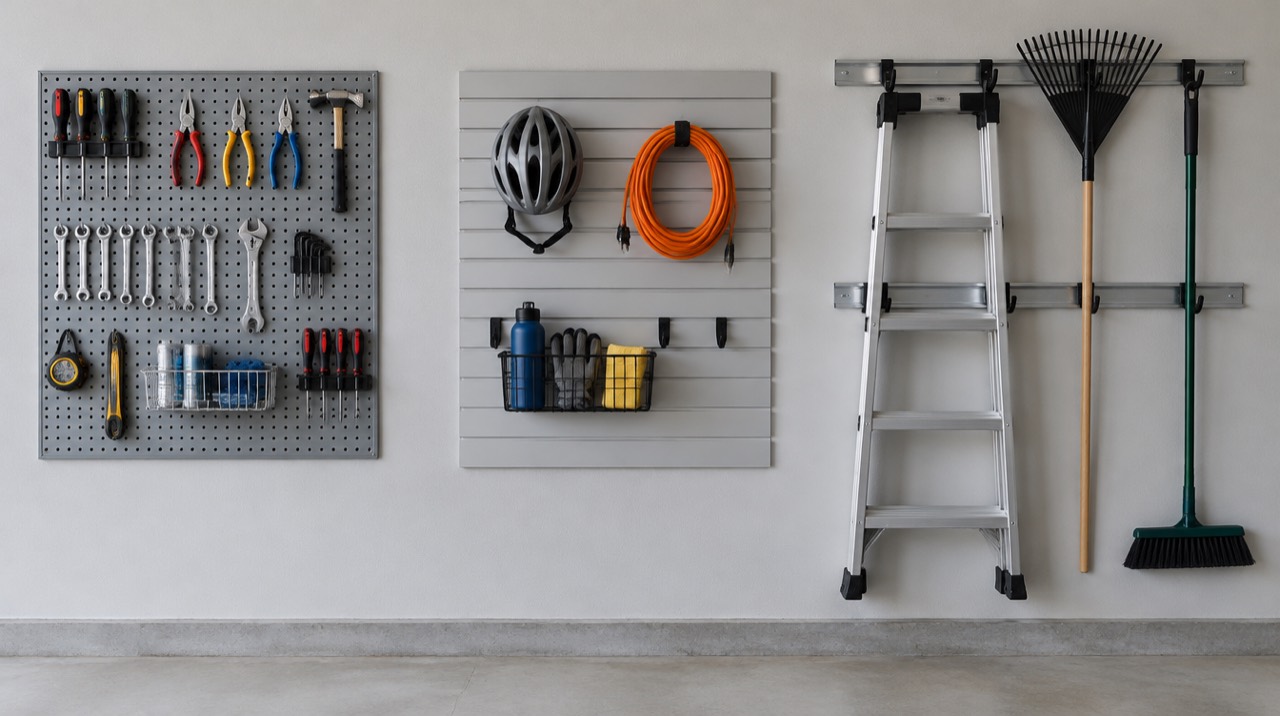
Track rails are horizontal steel or polymer rails screwed to the wall in a line, with hooks that hang on the rail profile. Rubbermaid FastTrack and Gladiator GearTrack are the two big names on Amazon; both also sell hooks, baskets and shelves for their own rails. Our FastTrack vs GearTrack comparison covers those two in detail.
Slatwall is a set of horizontal panels with continuous T-shaped slots, usually 12 inches tall per panel (Gladiator GearWall) or sold as 4 x 8 ft sheets (Proslat). It covers a wall and takes hooks, baskets, bins and shelves in any slot. Gladiator’s GearTrack channels and GearWall panels use the same hooks.
Pegboard is a sheet with a grid of round holes. Traditional pegboard is typically thin hardboard, mounted on spacers or furring strips so the hooks can pass behind it. Steel pegboard, such as Wall Control, is 20-gauge steel with a formed flange that holds it off the wall.
Published ratings, side by side
| System | Example | Published rating | Mounting the maker specifies |
|---|---|---|---|
| Steel track rail | Rubbermaid FastTrack 48 in rail ($125.00) | Up to 1,750 lb “when properly mounted” | Studs at 16 or 24 in; 48 in rail must hit 4 studs for max capacity |
| Polymer track | Gladiator GearTrack 48 in channels | 75 lb per linear foot (300 lb per 48 in) | Wood studs, drywall over wood studs, or masonry |
| Slatwall panel | Gladiator GearWall 12 x 96 in panels | 50 lb per sq ft | Same as GearTrack |
| PVC slatwall sheet | Proslat 4 x 8 ft PVC slatwall | 75 lb per sq ft | Hidden-screw design; follow Proslat’s install guide |
| Steel pegboard | Wall Control 20-gauge steel | Hooks up to 25 lb (heavy-duty); one kit 200 lb total | Studs on 16 in centers, or drywall with anchors; cleat for 24 in studs |
| Hardboard pegboard | Generic 1/4 in sheet | No maker rating found | Spacers or furring strips into studs |
Price as of November 18, 2026, 4:08 PM ET. Prices and availability are accurate as of the date/time indicated and are subject to change. Any price and availability information displayed on Amazon.com at the time of purchase will apply to the purchase of this product.
Gladiator says its 75 lb per foot rating is based on a lab test at 300 lb per linear foot at -30 and 150 degrees F, per the spec text Gladiator’s dealer Abt publishes. Rubbermaid’s 1,750 lb figure comes from its Amazon listing; we could not load Rubbermaid’s own page to see the test basis.
Read these numbers carefully. A panel rating per square foot is not a hook rating. Gladiator’s Scoop Hooks are rated 25 lb each and its packs list hooks from 5 to 50 lb. Rubbermaid’s FastTrack kit says locking hooks hold 50 lb and non-locking hooks 25 lb. On every system, the smallest of three numbers governs: the hook, the panel or rail, and the fasteners into your wall. On our arithmetic, a 12 x 96-inch GearWall panel at 50 lb per square foot is 400 lb nominal for the panel; you will never put that on it with 25 lb hooks, but it tells you the panel is not the weak link.
Mounting: studs decide everything
All three systems publish their ratings assuming fasteners in wood studs or masonry.
- FastTrack: Rubbermaid’s install sheet says the rail must begin and end on studs, a 48-inch rail must hit four studs for maximum weight capacity, and that maximum “is not possible” on 24-inch stud spacing. Between studs it uses plastic drywall anchors every 8 inches, which add support but are not where the rating comes from. Suggested rail heights are 7 ft 3 in and 4 ft.
- Gladiator: GearTrack and GearWall mount to wood studs, over drywall into wood studs, or to masonry. Color-matched screws are sold separately for the panels.
- Wall Control: panels have pre-drilled mounting holes on 16-inch centers for studs, or mount into drywall with anchors. For 24-inch or irregular studs, and for metal studs, Wall Control sells a steel cleat that you fasten wherever the wall will take a screw.
Why drywall alone is a poor bet: a CPSC staff report on furniture anchoring notes that drywall cannot typically withstand a 50 lb pull straight out from the wall, and that drywall anchors are strongest when the load pulls parallel to the wall. Wall storage loads mostly pull down (shear), which helps, but a ladder or bike hook levers outward. Put the heavy hooks over studs.
On a concrete-block garage wall, all three can be fastened with masonry screws or anchors; see garage shelves on concrete block walls for the anchor types.
Accessory lock-in and cost over time
The rail or panel is a small part of the spend. Hooks, baskets and shelves are where the money goes, and they are brand-specific.
- Pegboard is the most open: hooks for round-hole pegboard are made by many brands, and Wall Control says its steel pegboard accepts standard 1/4-inch pegboard pegs as well as its own slotted hooks.
- Gladiator hooks fit both GearTrack channels and GearWall panels, so you can start with a channel and later add panels without changing hooks. Gladiator gives its hooks a lifetime limited warranty and the channels and panels 10 years.
- Rubbermaid FastTrack hooks, baskets and shelves fit FastTrack rails. Third-party hooks that say they are compatible exist on Amazon; check the rail profile before buying.
Assume nothing crosses between systems. Choose one system per wall so every hook you buy works everywhere on that wall.
Pros and cons
Track rails
- Pros: cheapest way to hang long-handled tools and chairs; rails span several studs; easy to add a second row.
- Cons: only one line of hooks per rail; shelves and baskets are smaller; hooks are brand-specific.
Slatwall
- Pros: hooks, bins and shelves anywhere on the wall; published per-square-foot ratings; finished look; easy to rearrange.
- Cons: most expensive per foot; panels cover outlets and need trim; still needs studs or masonry behind it.
Pegboard
- Pros: cheap; many hook styles; hand-tool outlines keep a bench organized.
- Cons: hardboard has no published rating and hooks can pull out; small hooks suit small tools only; steel pegboard costs more.
Featured alternative: plain wall shelves
If what you need on the wall is a flat surface for paint, sprays and bins rather than hooks, a bracket shelf may beat all three systems.

Check the current price of the FOFARY 1.64 x 4 ft wall shelving 2-pack on Amazon.
$129.99Price as of November 18, 2026, 4:08 PM ET. Prices and availability are accurate as of the date/time indicated and are subject to change. Any price and availability information displayed on Amazon.com at the time of purchase will apply to the purchase of this product.

FOFARY also sells a shallower 24 x 12-inch wall shelf 2-pack ($39.99) (Featured, disclosed relationship). Its listing gives 150 lb per shelf in the bullets, 200 lb total in the highlights and 100 lb in the spec table, so plan on the lowest until the label on the unit says otherwise. Our wall-mounted garage shelves guide compares these with FLEXIMOUNTS’ 2 x 6 ft shelves.
Price as of November 18, 2026, 4:08 PM ET. Prices and availability are accurate as of the date/time indicated and are subject to change. Any price and availability information displayed on Amazon.com at the time of purchase will apply to the purchase of this product.
Which to choose
- Side wall next to the car, long tools and chairs: a steel track rail at about 4 ft and another near 7 ft, screwed into every stud it crosses.
- Whole back wall of mixed gear you rearrange often: slatwall, starting with the band at eye level and adding panels later.
- Workbench wall with hand tools: steel pegboard if you hang heavier tools; hardboard if budget rules and the tools are light.
- Paint and small bins: wall shelves on studs, or slatwall shelves if you already have slatwall.
- Heavy totes: none of these. Use floor shelving; see best garage shelving.
Mistakes to avoid
- Trusting drywall anchors for a ladder or bike hook. Put heavy hooks over studs.
- Reading a panel rating as a hook rating. The hook’s own number governs.
- Mixing brands on one wall. Your hooks will not move between systems.
- Covering outlets and the electrical panel. Plan cut-outs and leave the panel fully accessible.
- Skipping the plan. Decide what goes on each wall first; our garage storage plan by zone shows how.
Check the current price on Amazon for the rail or panel starter pack, then budget for the hooks you will actually need.
Frequently asked questions
Is slatwall better than pegboard?
For a whole garage wall holding bikes, bins and heavy hooks, yes: slatwall panels publish real load ratings (Gladiator rates GearWall at 50 lb per square foot, Proslat its PVC slatwall at 75 lb per square foot) and hooks lock into continuous slots. For small hand tools over a workbench, pegboard is cheaper and the hooks are interchangeable across brands. Steel pegboard such as Wall Control sits between the two.
How much weight can a garage track rail hold?
Gladiator rates GearTrack at 75 lb per linear foot, so a 48-inch channel is 300 lb. Rubbermaid's listing says its steel FastTrack rail supports up to 1,750 lb when properly mounted, but its install sheet says a 48-inch rail must hit four studs for maximum capacity, which is not possible on 24-inch stud spacing. Individual hooks carry far less: 25 to 50 lb each on both systems.
Can I mount slatwall or track rails on drywall without studs?
Not for their rated loads. Gladiator says GearTrack mounts to wood studs, drywall over wood studs or masonry. Rubbermaid's FastTrack sheet says the rail must begin and end on studs and uses drywall anchors only between studs. A CPSC staff report notes that drywall cannot typically withstand a 50 lb pull straight out from the wall.
Do pegboard hooks fit slatwall?
No. Pegboard hooks are made for round holes (commonly 1/4 inch), slatwall hooks for horizontal slots, and track hooks for each maker's rail profile. Wall Control steel pegboard accepts standard 1/4-inch pegboard pegs as well as its own hooks. Assume hooks from one track or slatwall brand do not fit another.
What is the cheapest way to get tools off the garage floor?
A short track rail with a few hooks, screwed into studs, handles rakes, shovels and chairs for the least money per item. Hardboard pegboard over a workbench is cheapest for hand tools. Full slatwall costs the most per foot but covers the whole wall.
Keep planning
- Best Black Friday Garage Shelving Deals 2026: Gladiator and Husky
What to expect from garage shelving Black Friday deals in 2026. Gladiator, Husky, Costco and Amazon warehouse pricing compared.
Updated Nov 2026 - Fleximounts vs MonsterRax Overhead Racks
Fleximounts vs MonsterRax overhead garage racks compared on published specs: capacity, ceiling drop, joist spacing, concrete ceilings, sizes and warranty.
Updated Oct 2026 - Garage Cabinets vs Open Shelving: Capacity, Dust and Cost
Garage cabinets vs open shelving compared on published specs: per-shelf load ratings, depth for totes, dust, locking, cost per foot and anchoring.
Updated Oct 2026