Mounting Garage Shelves on Concrete Block or Brick Walls
In this guide
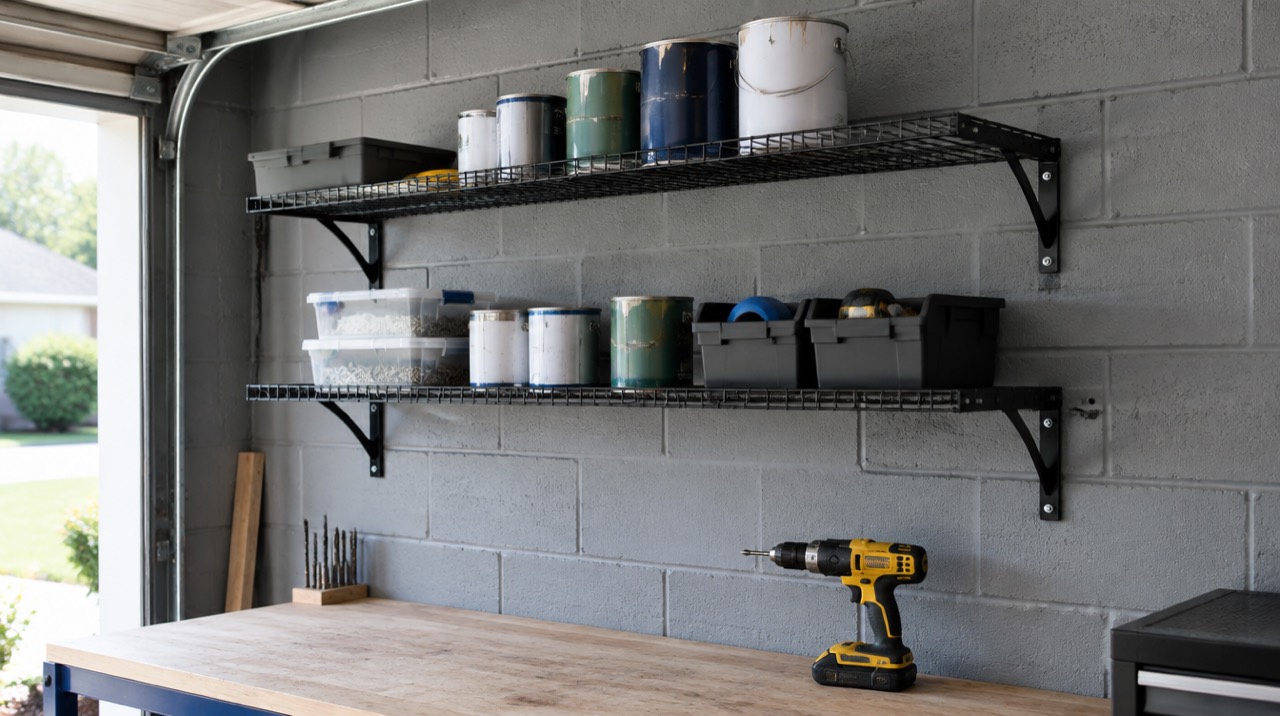
You can hang garage shelves on a concrete block (CMU) or brick wall, but the anchor, not the shelf, sets the limit, and hollow block holds far less per anchor than solid concrete. The short answer: identify whether your wall is hollow block, grouted block, solid brick or brick veneer; use anchors whose maker publishes hollow-block values; drill into the block face, not the mortar; and for heavy shelves, anchor a wood ledger to the wall first so the load spreads over many anchors. This guide is spec-based: it uses anchor makers’ published load tables and shelf listings checked on 2026-10-28, not tests of our own. Disclosure: As an Amazon Associate I earn from qualifying purchases. Some brands featured below (FOFARY, REIBII, Lionhon) pay a bonus commission through Amazon Creator Connections. See /disclosure/.
First, find out what the wall is
The same drill bit goes into four very different walls, and they hold very differently.
| Wall type | How to recognize it | What anchors bite into |
|---|---|---|
| Hollow concrete block (CMU) | Blocks about 16 x 8 in on the face; the bit breaks through into a void after roughly an inch | Only the face shell, about 1 to 1-1/4 in thick |
| Grouted (filled) block | Same face, but the bit keeps going through solid material | Full depth of grout; much stronger |
| Solid brick (structural) | Several layers deep, often older or load-bearing | Solid brick, but brittle; varies a lot |
| Brick veneer | One layer of brick in front of a framed or block wall, with an air gap | The thin brick only, unless you reach the wall behind |
Most garage block walls are hollow with a few grouted cells, typically where there is reinforcing steel. You will not know which cells are grouted until you drill. A test hole with a long masonry bit tells you: if the bit drops through after about an inch, you are in a hollow cell.
Plan as if every anchor lands in hollow, lightweight block. If you hit grout, you have extra margin.
What one anchor in hollow block really holds
Tapcon (ITW Red Head) publishes ultimate tension and shear values for its screw anchors in hollow block, with a 1-inch embedment, in its technical data sheet. It also states that safe working loads for a single anchor under static load should not exceed 25% of the ultimate value. That gives:
| Tapcon in hollow block (1 in embedment) | Ultimate tension | Ultimate shear | 25% working tension (our math) | 25% working shear (our math) |
|---|---|---|---|---|
| 3/16 in, lightweight block | 220 lb | 400 lb | 55 lb | 100 lb |
| 3/16 in, medium-weight block | 340 lb | 730 lb | 85 lb | 182 lb |
| 1/4 in, lightweight block | 250 lb | 620 lb | 62 lb | 155 lb |
| 1/4 in, medium-weight block | 500 lb | 1,000 lb | 125 lb | 250 lb |
Two things stand out. Tension (pull straight out of the wall) is the weak direction, and lightweight block holds about half what medium-weight block does. You cannot tell block density from looking at a painted wall, so use the lightweight row.
The same sheet lists a 4-inch spacing and 4-inch edge distance for full capacity in CMU, with reduced capacity down to 2 inches. Treat “edge” as the end of the wall, a door or window opening, and the top of the wall. Tapcon’s drill bits are specific: a 5/32-inch bit for a 3/16-inch anchor and a 3/16-inch bit for a 1/4-inch anchor. A distributor’s Tapcon installation summary adds that the hole is drilled with a hammer drill and an ANSI carbide bit, at least 1/2 inch deeper than the screw will reach, and cleaned out before you drive the screw.
Simpson Strong-Tie’s Titen HD screw anchor is also evaluated for the face of hollow CMU and for grouted block in its ICC-ES report (ESR-1056); read its hollow-face table for the size you buy rather than borrowing concrete values. Sleeve anchors are another option because they expand along their length and can grip hollow material, per Eugene Fasteners’ sleeve anchor guide; over-tightening can crack the face shell, so torque to the maker’s figure.
Mortar joints. None of the anchor data we read gives values for a mortar joint. Put anchors in the block face.
Why wall shelves pull out at the top
A wall shelf is a cantilever. The load sits out in front of the wall, so the bracket tries to rotate: the bottom presses into the wall and the top anchor is pulled outward. That puts the weakest direction, tension, on the top anchor.
A worked example, with assumptions stated (this is our arithmetic, not a maker’s rating):
- A 20-inch-deep shelf carrying 150 lb, on two brackets: 75 lb per bracket.
- If the load is spread evenly, its center is about 10 inches from the wall.
- If the bracket’s top and bottom anchors are 8 inches apart vertically, the top anchor sees roughly 75 x 10 / 8 = about 94 lb of pull-out.
That is above the 62 lb working tension for a single 1/4-inch Tapcon in lightweight hollow block. The fixes are to add anchors per bracket, use brackets with taller backs (more distance between anchors means less pull), keep the heaviest items close to the wall, or spread the load onto a ledger.
The ledger method: spread the load first
The most forgiving way to hang shelves on block is to anchor a continuous wood ledger to the wall, then screw the shelf brackets or rails to the ledger.
- Choose the ledger. A straight 2x4 laid flat or a strip of 3/4-inch plywood, long enough to span all brackets with a few inches to spare.
- Lay out anchors. Mark anchors into block faces, roughly every 16 inches and staggered top and bottom if the ledger is tall enough, at least 4 inches from the end of the wall and the edges of openings. Avoid mortar lines.
- Drill through the ledger, then the block. Use a hammer drill and the anchor maker’s bit size. Drill deeper than the embedment, blow or vacuum the dust out.
- Drive the anchors with a washer under the head, snug, not over-torqued.
- Fasten brackets to the ledger with structural wood screws long enough to penetrate well into the wood. The bracket can now go anywhere along the ledger.
- Load gradually and check that nothing has moved before you fill the shelf.
A ledger turns six or eight anchors into one load path, so no single anchor carries a full bracket’s pull. It also lets you use wall shelves designed for 16-inch studs on a wall that has no studs at all. If you are planning several walls, see our garage storage ideas by zone to decide what goes where.
Featured wall shelf for masonry walls

Check the current price of the FOFARY 1.64 x 4 ft wall shelving 2-pack on Amazon ($129.99). For comparison, FLEXIMOUNTS’ listing for its 2 x 4 ft wall shelving says it mounts to concrete and solid brick but not brick veneer, hollow brick or metal studs, which is the kind of explicit wall-type statement worth looking for in any shelf. Our wall-mounted garage shelves guide compares both on depth and capacity.
Price as of November 18, 2026, 4:08 PM ET. Prices and availability are accurate as of the date/time indicated and are subject to change. Any price and availability information displayed on Amazon.com at the time of purchase will apply to the purchase of this product.
Freestanding shelving against a block wall
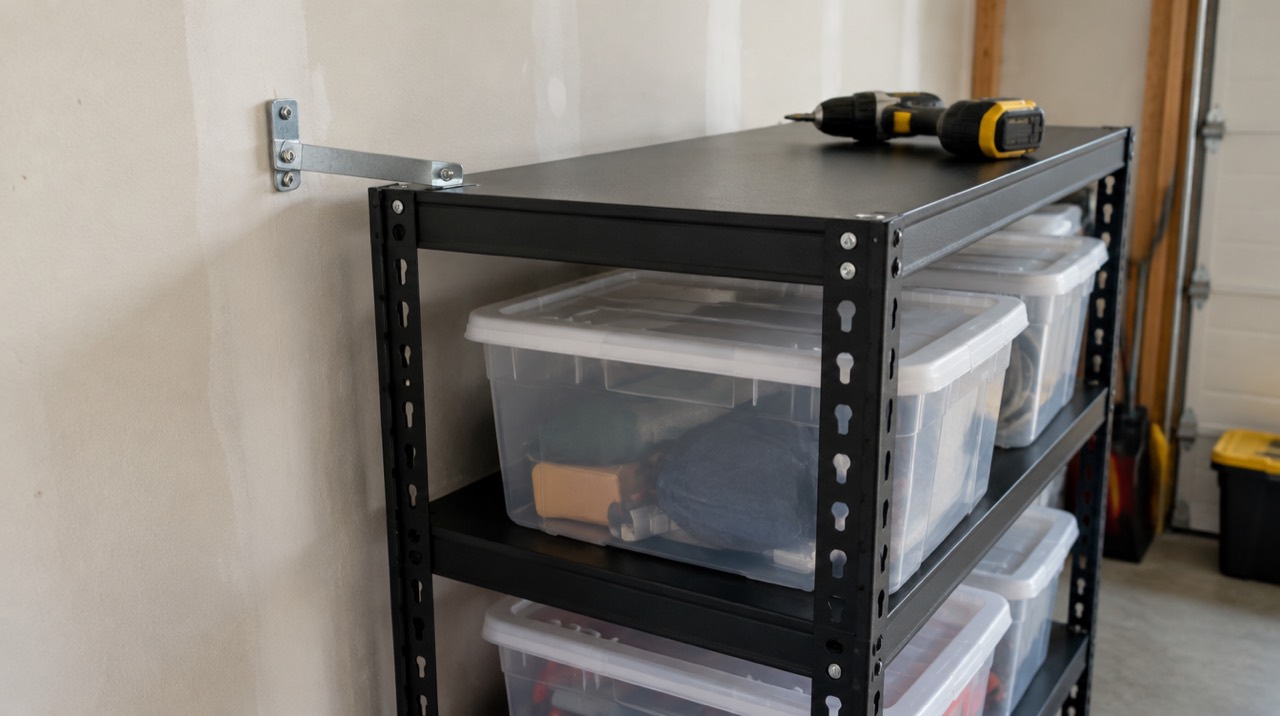
If your loads are heavy (paint by the case, bagged concrete, full totes), a freestanding steel unit carries the weight on the floor, and the block wall only has to stop it tipping. That is a much smaller job for the anchors.


Check the current price of the REIBII 48.2 x 24.5 x 72 in shelving on Amazon ($175.98) or the Lionhon 59 x 23 x 67 in shelving on Amazon ($125.99). Our REIBII vs Lionhon comparison goes through the differences in detail.
Price as of November 18, 2026, 4:08 PM ET. Prices and availability are accurate as of the date/time indicated and are subject to change. Any price and availability information displayed on Amazon.com at the time of purchase will apply to the purchase of this product.
To secure either unit to block:
- Level it first. Garage slabs slope toward the door; shim the feet so the unit stands plumb.
- Anchor near the top, at the rear posts, with a strap or L-bracket into the block face. A 1/4-inch screw anchor in a properly drilled hole is a typical choice; a tip restraint mostly sees a modest pull only when someone tugs the unit.
- Keep the strap short so the unit cannot gain momentum before it catches.
The step-by-step version, including studs and straps, is in how to anchor garage shelving to the wall.
Brick walls: solid or veneer?
Brick deserves its own caution. A brick veneer wall is a single layer of brick with an air gap and a framed or block wall behind it. Anchors in veneer hold only in that one brick, and the veneer is tied to the wall behind with light metal ties; it was never designed to carry a cantilevered shelf. Options, in order of preference:
- Reach the structure. If there are wood studs behind the veneer, long structural screws through the brick and air gap into the studs can work, but the screws must be long enough to embed solidly in wood after crossing the gap.
- Go freestanding. Put the weight on the floor and use the wall only to stop tipping.
- Keep loads light if you must anchor into the brick itself, and use anchors whose maker publishes brick values.
Solid structural brick takes masonry anchors well, but brick varies in hardness and can spall near edges. Drill into the brick, not the joint, and stay away from the corners of bricks.
Tools and mistakes to avoid
You need: a hammer drill (a regular drill struggles in block), carbide masonry bits in the anchor maker’s sizes, a shop vac or blow-out bulb, a 4-foot level, a stud finder for any wood ledger work, eye protection and a dust mask.
Mistakes:
- Relying on plastic plugs in hollow block for loaded shelves.
- Drilling into mortar because it is easier. It is also weaker.
- Using concrete values for block. A 1/4-inch Tapcon’s ultimate tension in 2,000 psi concrete at 1-inch embedment is 750 lb in the same Tapcon sheet; in lightweight hollow block it is 250 lb.
- Anchors too close together or too close to the end of a wall.
- Over-tightening, which spins the screw in the hole or cracks the face shell. If it spins, move over and drill a new hole.
- Forgetting the cantilever. Heavy items go at the back of the shelf, close to the wall.
Bottom line
On block, plan around hollow, lightweight block and the anchor’s working load, which is a quarter of the published ultimate value. Drill into the face, spread wall shelves onto a ledger anchored every 16 inches or so, and put truly heavy storage on a freestanding unit strapped to the wall. For deciding how much a shelf will actually carry once loaded, see garage shelving weight capacity math.
Frequently asked questions
Can I hang heavy shelves on a cinder block wall?
Yes, if you size the anchors to hollow block, which is much weaker than solid concrete. Tapcon's published ultimate values for a 1/4 in screw anchor 1 in into hollow block are 250 lb tension and 620 lb shear in lightweight block, 500 lb and 1,000 lb in medium-weight block, and Tapcon says safe working loads should not exceed 25% of those figures. Spread the load over more anchors, or anchor a wood ledger to the block and fasten the shelf brackets to the ledger.
Are Tapcons or sleeve anchors better for hollow block?
Both are used in block. Tapcon screw anchors publish hollow-block values and need only a small pilot hole; sleeve anchors expand along their length and can grip hollow material. What matters is that the anchor's maker publishes values for hollow concrete masonry and that you install it to their instructions (bit size, hole depth, edge distance). Plastic expansion plugs are the weakest choice for a loaded shelf in hollow block.
Should I drill into the mortar joint or the block?
Into the block face. The Tapcon and Simpson Strong-Tie data we read gives values for anchors in the face shell of the block; we found no published values for mortar joints. Keep anchors at least 4 in apart and 4 in from the end of the wall, openings and the top course where you can, which is Tapcon's full-capacity spacing and edge distance in CMU.
My garage wall is brick. Is that the same as block?
Often not. Many brick garage walls are veneer: a single layer of brick tied to a wood or block wall behind it with an air gap. Some shelf makers exclude it; FLEXIMOUNTS' listing for its wall shelves says not to mount to brick veneer or hollow brick. Find out what is behind the brick before you load it, and anchor into the structural wall where possible.
How do I anchor a freestanding steel shelf to a block wall?
Use the unit's anti-tip strap or bracket near the top and fasten the wall side into the block face with a masonry anchor, such as a 1/4 in Tapcon in a hammer-drilled pilot hole. A tip restraint carries a small load compared with a cantilevered wall shelf, so one or two properly installed anchors per unit are typical. Level the unit first; garage slabs slope toward the door.
Keep planning
- Anchor Garage Shelving to the Wall in 7 Steps
Anchor garage shelving near the top into a wood stud or masonry, not drywall alone, with a strap or bracket. See the 7 steps (about 20 minutes).
Updated Oct 2026 - How to Assemble Boltless (Rivet) Shelving: Steps and Mistakes
How to assemble boltless rivet shelving the way the manuals say: keyholes narrow end down, beams ledge-up, seat every rivet, level, anchor, avoid mistakes.
Updated Oct 2026 - Garage Ladder Storage: Wall Hooks, Ceiling Racks and Hoists
Garage ladder storage compared: wall hooks for frequent use, ceiling racks for rare use, pulley hoists for high ceilings, with weights, ratings and mounting.
Updated Oct 2026