Garage Shelving Weight Capacity Math for Real Loads
In this guide
A shelf’s rating is the most it can hold when the load is spread evenly over the whole shelf, on a level, correctly assembled unit. Real garage loads rarely look like that, so the math is simple but worth doing: weigh or estimate each item, add up each shelf, compare to the per-shelf rating (not the unit total), and keep a margin. Most people never come close on a shelf of totes; the shelves that do get overloaded hold paint, bagged concrete, water, hardware and books. This guide is spec-based: weights come from manufacturer data sheets and product pages checked on 2026-10-28, and the shelving examples from published listings, not tests of our own. Disclosure: As an Amazon Associate I earn from qualifying purchases. Some brands featured below (DurayLoly, REIBII, Lionhon) pay a bonus commission through Amazon Creator Connections. See /disclosure/.
What a rating actually promises
Read the manual, not just the title. Edsal’s assembly manual for its UR-series boltless units (PDF) is typical. It caps each shelf at 800 lb and the unit at 4,000 lb, tells owners to distribute weight evenly across the entire shelf surface, put heavier items on the bottom, set the unit on a level surface and secure it to a wall. Four assumptions are built into every rating:
- Even distribution. The load covers the shelf, not one spot in the middle.
- Static load. Things are placed, not dropped or swung.
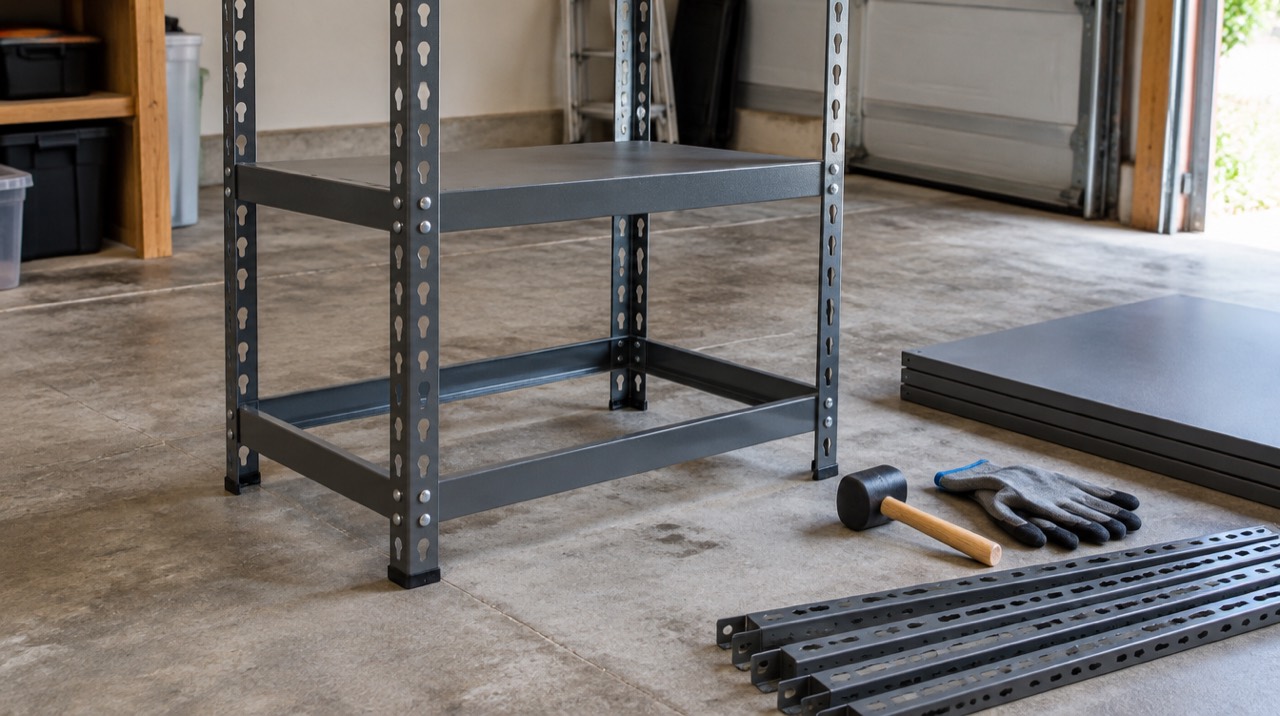
- Correct assembly. Every beam fully seated, every pin or rivet engaged.
- Level floor. No lean that shifts load onto two posts.
Garage reality breaks at least one of these most of the time, which is why a margin matters.
Per shelf vs total
Listings often give two numbers, and the total can mislead. A unit rated 3,000 lb with 5 shelves does not let you put 1,000 lb on one shelf. Use the per-shelf rating to load each shelf and the total as a check that all shelves together stay under it.
When only a total is published, divide by the number of shelves as an estimate. When two figures conflict, use the lower one. Published examples (Amazon listings, checked 2026-10-28):
| Unit | Size (W x D x H) | Per shelf (listed) | Total (listed) | Notes |
|---|---|---|---|---|
| Lionhon 4-tier | 59 x 23 x 67 in | Up to 1,125 lb, evenly distributed | 4,500 lb | Per-shelf x 4 = total |
| REIBII 5088 lb wire rack | 68.3 x 23.4 x 72 in | 1,272 lb | 5,088 lb | Wire deck |
| REIBII 5-tier | 48.2 x 24.5 x 72 in | 602 lb | 3,010 lb | Listing says it holds 5 standard 27-gal totes |
| REIBII 2-pack, each unit | 36 x 16 x 72 in | 480 lb | 2,400 lb (title) vs 2,020 lb (spec table) | Plan on the lower figure |
| REIBII rolling 4-tier | 31.5 x 16.5 x 59.8 in | Not stated | 2,080 lb on feet, 530 lb on casters | Wheels cut the rating by about 75% |
| DurayLoly 4-tier | 45 x 13.5 x 59.4 in | Not stated in the text we read | 800 lb | 800 / 4 = 200 lb per shelf (our estimate) |
The rolling unit is the clearest lesson in the table: the same frame drops from 2,080 lb to 530 lb on casters. Wheels, not shelves, become the limit.
What things weigh
Use the label when there is one; bagged products print their weight. For everything else:
| Item | Weight | Source |
|---|---|---|
| Gallon of latex paint | About 10 to 11 lb | PPG SUN PROOF data sheet: 10.9 lb/gal; Rust-Oleum acrylic sheet: 9.8 to 11.3 lb/gal |
| Gallon of water (jug, bottled water) | About 8.3 lb | Unit arithmetic: 3.785 L at about 1 kg/L |
| 5-gallon bucket of water | About 42 lb | Our arithmetic, plus the bucket |
| Bag of concrete mix | 40, 50, 60 or 80 lb | QUIKRETE Concrete Mix bag sizes |
| Passenger tire | About 25 lb average | USTMA scrap-tire reporting; more on a wheel |
| 27-gallon tote, packed | Weigh it | Contents vary from light decor to heavy tools |
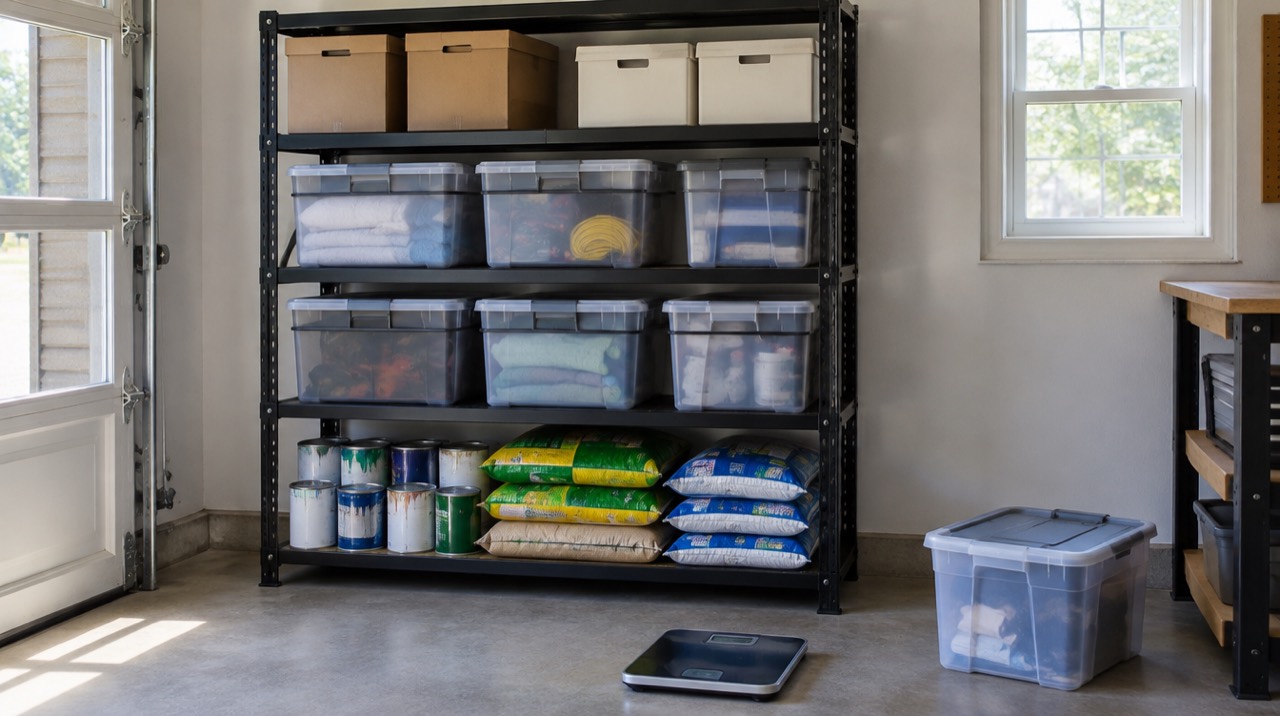
Totes are the wild card. A Sterilite 27-gallon industrial tote measures 28 1/2 x 19 5/8 x 15 1/2 inches (Sterilite) and holds about 3.6 cubic feet. Filled with clothes or holiday decor it is light. Filled with books, hand tools or hardware it can become too heavy to lift safely long before it threatens a shelf. Weigh a representative tote of each type once: stand on a bathroom scale holding it and subtract your own weight. Write the weight on the tote’s label.
Worked examples
Shelf of paint (bottom shelf of a 48-inch unit):
- 12 gallons of latex paint at about 11 lb = 132 lb
- 4 quarts and some spray cans, say 15 lb
- Total about 147 lb. Comfortable on any of the units above, including the 200 lb-per-shelf estimate for the DurayLoly. Paint is heavy for its size but rarely fills a shelf with weight.
Shelf of totes (middle shelf, 24-inch-deep unit):
- Two 27-gallon totes of holiday decor, weighed at 22 lb and 28 lb = 50 lb
- Total 50 lb. Totes of light goods almost never stress a heavy-duty shelf; the depth and clearance matter more. Our shelving depth for totes guide covers fit.
Shelf of bagged materials (bottom shelf):
- Four 80 lb bags of concrete mix = 320 lb
- Two 40 lb bags of water-softener salt (label weight) = 80 lb
- Total 400 lb. That exceeds the DurayLoly estimate by double, sits near the 480 lb REIBII 36-inch figure with little margin, and is comfortable only on the 600 lb-plus units. Stack bags flat across the full shelf, not in one pile in the middle.
Shelf of water and drinks (bottom shelf):
- Eight cases of 24 half-liter bottles: each case is 12 liters of water, about 26 lb, so about 212 lb plus packaging.
- Total about 220 lb. Fine on heavy-duty units; over the estimate for a light-duty 200 lb shelf.
Featured: matching the unit to the load

Check the current price of the DurayLoly 45-inch 4-tier rack on Amazon.
$81.99Price as of November 18, 2026, 4:08 PM ET. Prices and availability are accurate as of the date/time indicated and are subject to change. Any price and availability information displayed on Amazon.com at the time of purchase will apply to the purchase of this product.


Check the current price of the REIBII 48.2 x 24.5 x 72 in shelving on Amazon ($175.98) or the Lionhon 59 x 23 x 67 in shelving on Amazon ($125.99). Our REIBII vs Lionhon comparison covers them side by side, and heavy-duty garage shelving explains how to read ratings across brands.
Price as of November 18, 2026, 4:08 PM ET. Prices and availability are accurate as of the date/time indicated and are subject to change. Any price and availability information displayed on Amazon.com at the time of purchase will apply to the purchase of this product.
Point loads: the hidden overload
A 300 lb anvil in the center of a 600 lb shelf is not half the rating. The rating assumes the load spreads to all four beams; a concentrated load in the middle makes the shelf panel or wire deck bend between the beams. Rules of thumb (general practice, not a maker’s figures):
- Spread heavy items across the full width and depth.
- Put a plywood sheet under small heavy items on a wire deck so they bear on more of the deck.
- Keep the heaviest items over or near the beams, especially at the front and back edges.
- Watch for sag. A visibly bowed shelf is overloaded for that arrangement, whatever the label says. Unload and redistribute.
A simple checklist
- Find the per-shelf rating in the manual or listing; if figures conflict, use the lowest.
- Weigh or look up each heavy item; total each shelf.
- Keep each shelf to about half to two-thirds of its rating for everyday use (our rule of thumb).
- Heaviest shelf at the bottom, lightest at the top.
- Spread the load; no single heavy item in the middle.
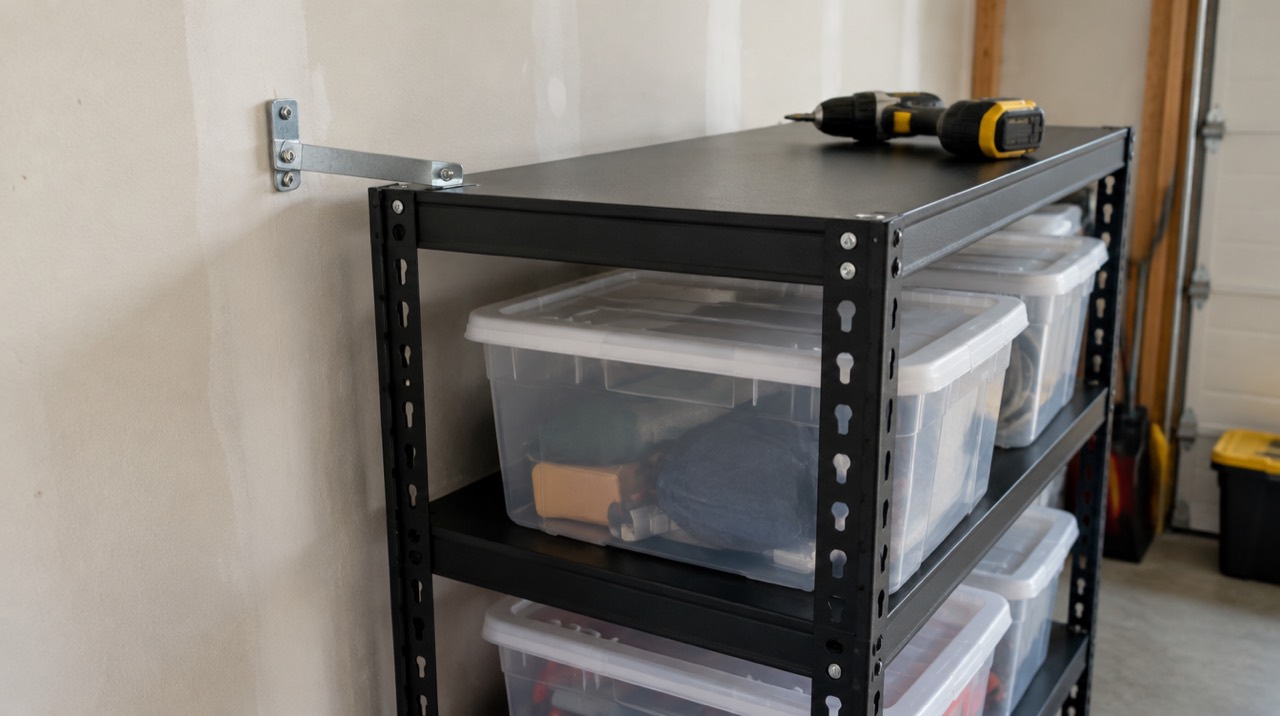
- Level the unit and anchor it to the wall. See how to anchor garage shelving.
- If it rolls, use the caster rating, not the fixed-feet rating.
Bottom line
Use the per-shelf number, add up what is actually on each shelf, and keep a margin. Totes of light goods rarely matter; paint, water, bagged materials and hardware do. Put those on the bottom of a unit whose per-shelf rating clears them comfortably, spread them out, and anchor the unit. For choosing a unit, start with our best garage shelving roundup.
Frequently asked questions
How much weight can a garage shelf actually hold?
Up to its published per-shelf rating, and only when the load is spread evenly across the whole shelf on a level, properly assembled unit. Edsal's manual for its UR-series units, for example, gives 800 lb per shelf and 4,000 lb per unit and tells owners to distribute weight evenly across the entire shelf surface. A heavy item concentrated in the middle of a shelf is a different, harsher load than the rating describes.
If a unit is rated 2,000 lb with 5 shelves, is each shelf 400 lb?
Only if the maker says so. Many listings give both a per-shelf and a total figure; use the per-shelf one. If only a total is given, dividing by the number of shelves is a reasonable estimate, but treat it as an upper limit and confirm with the manual or label. Where a listing gives two different figures, plan on the lower one.
How much does a gallon of paint weigh?
About 10 to 11 lb for typical latex paint. PPG's data sheet for SUN PROOF exterior satin acrylic latex gives 10.9 lb per gallon, plus or minus 0.2, and a Rust-Oleum water-based acrylic sheet gives 9.8 to 11.3 lb. Ten gallons on one shelf is roughly 110 lb before you count the cans.
How heavy is a full storage tote?
It depends entirely on what is in it, which is why the safest method is to weigh one: stand on a bathroom scale holding it and subtract your own weight. Clothes and holiday decor are light; books, tools and hardware are heavy. A 27-gallon tote holds about 3.6 cubic feet, so packing it with dense items can push it well past what you can lift safely.
Does anchoring a shelf to the wall increase its capacity?
No. Anchoring stops a unit tipping forward; it does not change what each shelf can carry. Load ratings come from the shelf, beams and posts, and heavier items still go on the bottom shelves.
What safety margin should I leave?
Plan everyday loads well below the published rating, for example around half to two-thirds, because real loads are rarely perfectly even, people lean on shelves, and totes get dropped on rather than placed. That margin is our rule of thumb, not a manufacturer requirement.
Keep planning
- Anchor Garage Shelving to the Wall in 7 Steps
Anchor garage shelving near the top into a wood stud or masonry, not drywall alone, with a strap or bracket. See the 7 steps (about 20 minutes).
Updated Oct 2026 - How to Assemble Boltless (Rivet) Shelving: Steps and Mistakes
How to assemble boltless rivet shelving the way the manuals say: keyholes narrow end down, beams ledge-up, seat every rivet, level, anchor, avoid mistakes.
Updated Oct 2026 - Garage Ladder Storage: Wall Hooks, Ceiling Racks and Hoists
Garage ladder storage compared: wall hooks for frequent use, ceiling racks for rare use, pulley hoists for high ceilings, with weights, ratings and mounting.
Updated Oct 2026