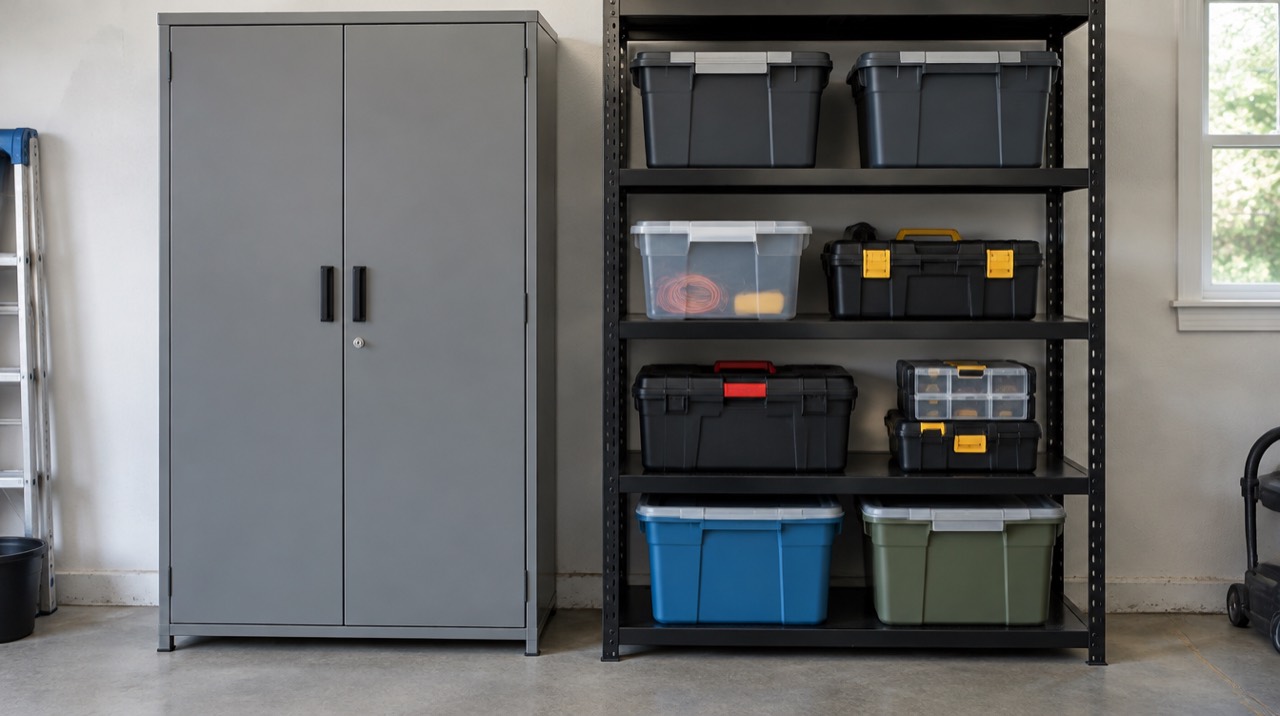
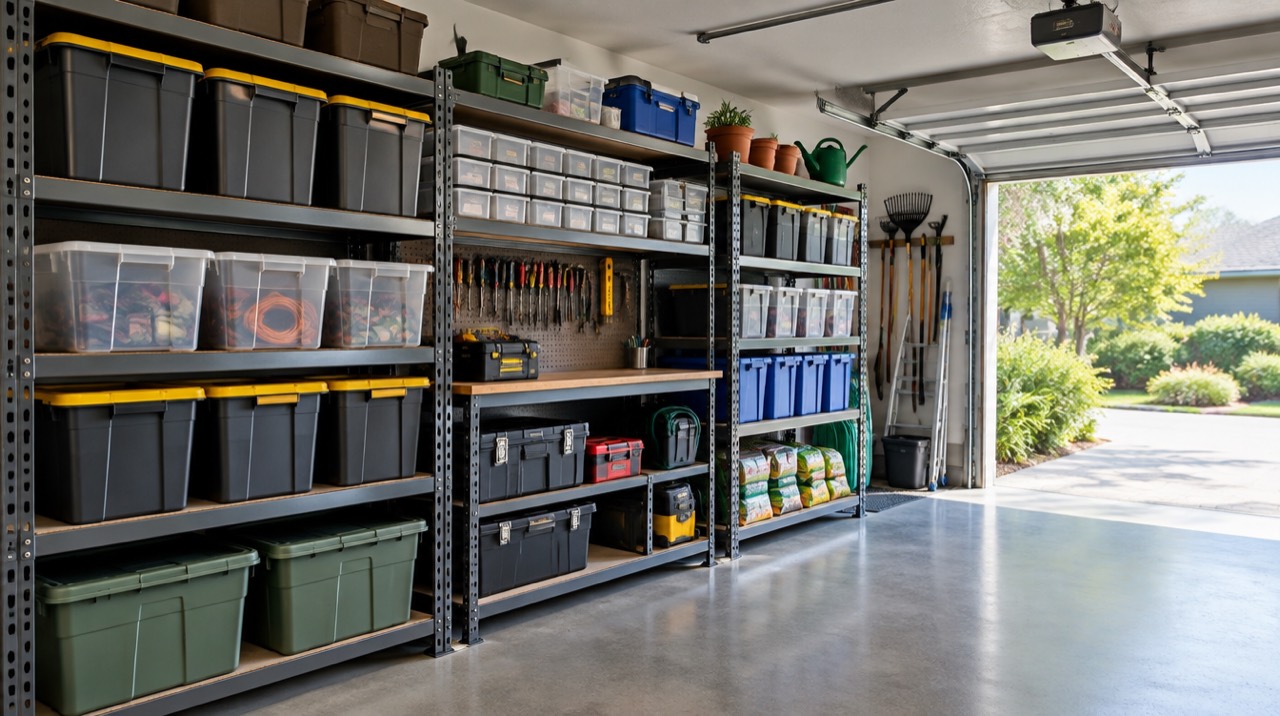
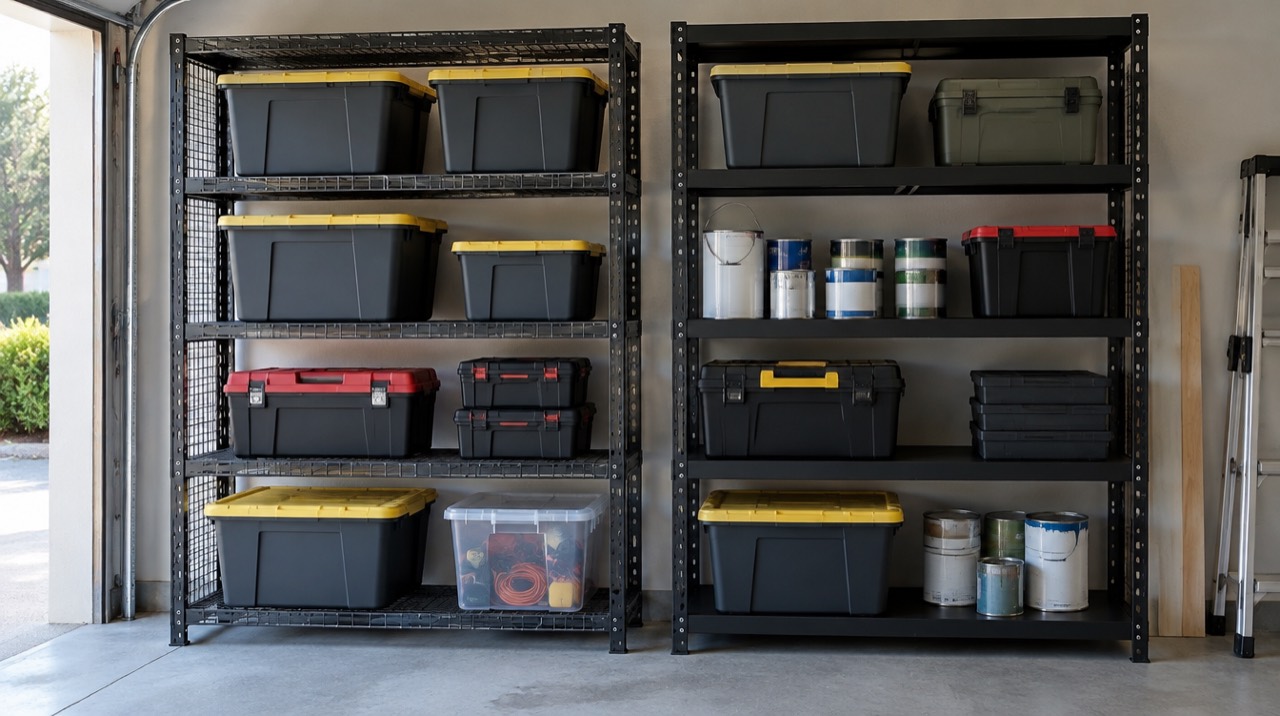
Choose open steel shelving for weight and totes, and cabinets for dust, looks and locking. On published numbers the gap is large: Gladiator rates its cabinet shelves at 40 to 50 lb each and Seville Classics rates its UltraHD cabinet’s adjustable shelves at 150 lb, while boltless garage shelving is commonly listed at 600 to 1,272 lb per shelf. Shelving also costs less for the same wall and fits 27-gallon totes two to a shelf. Cabinets win when you need to lock up chemicals or tools, keep things clean, or make the garage look finished. Most garages end up with both. This comparison is spec-based: every figure comes from manufacturer catalogs, product pages and listings checked on 2026-10-28.
Disclosure: As an Amazon Associate I earn from qualifying purchases. Some brands featured below pay a bonus commission through Amazon Creator Connections. See /disclosure/.
Price as of November 18, 2026, 4:08 PM ET. Prices and availability are accurate as of the date/time indicated and are subject to change. Any price and availability information displayed on Amazon.com at the time of purchase will apply to the purchase of this product.
Check the current price for each. All ratings assume weight spread evenly; the makers’ manuals and labels govern.
Two cautions on reading this table. First, none of these makers publishes a steel gauge we could find, so the table compares ratings, not material thickness. Second, the shelving ratings are listing claims with no named test standard; we treat them as upper limits and plan heavy loads below them (see reading heavy-duty load ratings). Even discounted heavily, open shelving carries several times what cabinet shelves are rated for. Gladiator’s own catalog makes the same split: its 77-inch rack shelving is listed at 2,000 lb per shelf, while its cabinets top out at 50 lb per shelf.
Why the difference? A cabinet’s shelves are formed sheet steel spanning between thin side panels, with weight carried through the cabinet box. Open shelving uses beams locked into upright posts, a structure designed for load first. Cabinets put their steel into doors, sides and backs instead.
Capacity and fit for totes
The common 27-gallon tote measures about 28.5 x 19.6 x 15.5 inches at the rim (Sterilite).
Storage
Depth
27-gal totes per shelf
18-inch-deep cabinet (most Gladiator units)
18 in exterior
None, the tote is deeper than the box
Seville Classics UltraHD Mega
22.25 in interior, 46 in wide
1 long side across, about 17 in left over
Lionhon 59-inch shelving
23 in
2
REIBII 68.3-inch wire rack
23.4 in
2 plus room for a small bin
REIBII 48.2-inch shelving
24.5 in
1 (or 2 turned sideways, with overhang)
If your storage is mostly totes, shelving wins on fit as well as weight. Our shelving depth for 27-gallon totes guide has the full fit chart.
Cabinets fit better for loose items: spray cans, hand tools, car-care bottles, small parts, sporting goods. Shallow 18-inch shelves keep things visible at the front instead of lost at the back of a 24-inch shelf.
Dust, moisture and pests
This is where cabinets earn their keep. Closed doors keep sawdust, pollen, road grit and leaves off what is inside, and make it harder for mice to nest in boxes. If you work wood in the garage or leave the door open for hours, anything on open shelves needs a lid.
Open shelving’s answer is lidded totes, which most people use anyway. Shelving also has an edge in a damp garage: air moves around and under everything, and wire decks let condensation drain. A closed cabinet in a humid garage can trap moisture, and Seville Classics labels its UltraHD cabinets for indoor use only. For damp garages, see rust-resistant garage shelving.
Visibility and access
Open shelving shows you everything at a glance, which is underrated in a garage: you can read tote labels from the car, spot what is running low and grab a box without opening two doors first. That also makes it easy to overload a shelf without noticing, so put the heaviest items on the lowest tiers.
Cabinets hide clutter but also hide inventory. People tend to stack things in front of things behind closed doors. Shallow cabinets (12 to 18 inches deep) and pull-out drawers work best because nothing gets lost at the back. If you choose cabinets for looks, label the shelf edges inside and keep a list on the door.
Door swing matters too. A 36-inch-wide two-door cabinet needs about 18 inches of clear floor in front for each door to open fully, which is space a parked car may take. Measure with the car in place before you buy. Open shelving needs only enough room to stand and pull a tote.
Security and child safety
Cabinets lock; shelving does not. Seville Classics’ UltraHD cabinets include locking doors with two keys. Gladiator’s catalog lists universal locks among its cabinet features. That matters for:
Pool chemicals, pesticides, fertilizers and cleaners in a home with children.
Expensive power tools in a garage with the door often open.
Anything a child should not open, such as lighter fluid, batteries and sharp blades.
An ordinary locking cabinet is not a fire-rated flammable cabinet, though. Gasoline, thinners and solvents need approved containers and, in some cases, a safety cabinet built to OSHA’s construction rule; see flammable storage cabinets for a garage.
Cost and assembly
We do not publish prices, so compare current listings yourself for the same width of wall. Expect a cabinet to cost more per foot than boltless shelving: it contains more sheet steel in its sides, back and doors, plus hinges, locks and finish work, while carrying far less weight per shelf. Price per pound of rated capacity is the fairest way to compare.
Assembly differs too. Boltless shelving goes together with a rubber mallet and few or no screws (boltless shelving assembly). Ready-to-assemble cabinets involve many screws, door alignment and hinge adjustment; the Seville Classics Mega cabinet weighs 132 lb, so plan on two people. Gladiator includes leveler legs on its floor cabinets, which helps on a sloped garage floor.
Anchoring applies to both
A tall cabinet with its doors open and weight on upper shelves can tip forward just as shelving can. The CPSC’s Anchor It campaign recommends anchoring furniture with shelves to the wall. Seville Classics’ Mega cabinet page does not mention an anchor kit; REIBII’s 5,088 lb wire rack lists two anti-tip kits; the Lionhon and REIBII 48.2-inch listings mention none. Plan to anchor every tall unit to a stud; anchoring garage shelving to the wall covers brackets and straps.
Which to buy
Your priority
Choose
Totes, bulk, heavy items
Open steel shelving
Lowest cost per foot of wall
Open steel shelving
Locking up chemicals or tools
Cabinet
Dusty workshop garage
Cabinets, or shelving with lidded totes
Damp, unconditioned garage
Open shelving with wire decks
Finished, showroom look
Cabinets
Renting, may move
Shelving (splits, packs flat, no wall system)
Featured (disclosed relationship): REIBII and Lionhon shelving
Both brands pay a bonus commission on the shelving units below; the picks are based on published per-shelf ratings and depth for totes. They are not for: anyone who needs to lock contents away, keep dust off loose items without totes, or wants a finished cabinet look. Neither brand names a test standard for its ratings.
Two totes per shelf, solid decks, shorter wall: the Lionhon 59 x 23 x 67-inch 4-tier ($125.99). Not for: five tiers or a unit with anchor hardware in the box.
Price as of November 18, 2026, 4:08 PM ET. Prices and availability are accurate as of the date/time indicated and are subject to change. Any price and availability information displayed on Amazon.com at the time of purchase will apply to the purchase of this product.
Most capacity per shelf, airflow in a damp garage: the REIBII 68.3-inch wire rack ($169.99), which lists two anti-tip kits. Not for: small loose items without a liner.
Price as of November 18, 2026, 4:08 PM ET. Prices and availability are accurate as of the date/time indicated and are subject to change. Any price and availability information displayed on Amazon.com at the time of purchase will apply to the purchase of this product.
Five tiers on a 4-foot wall: the REIBII 48.2-inch 5-tier ($175.98). Not for: two 27-gallon totes per shelf without overhang.
Price as of November 18, 2026, 4:08 PM ET. Prices and availability are accurate as of the date/time indicated and are subject to change. Any price and availability information displayed on Amazon.com at the time of purchase will apply to the purchase of this product.
For the lockable side, pick a cabinet by interior depth and per-shelf rating, and match it to what you will store: Gladiator’s catalog and Seville Classics’ product pages list both. Shelving alternatives are in best garage shelving and REIBII vs Lionhon.
A hybrid layout that works
Most garages get the best of both by splitting by item:
Open shelving on the long wall for totes, bulk paper goods, camping gear and anything heavy.
One lockable cabinet near the door to the house for chemicals, sprays and car-care products.
A low tool cabinet or drawer unit at the workbench for hand tools.
Lidded totes on the shelving for anything that must stay clean.
That puts weight where it is cheapest to carry and locks where they matter. See garage storage ideas by zone for where each piece goes.
Frequently asked questions
Which holds more weight, garage cabinets or shelving?
Open steel shelving, by a wide margin. Gladiator's catalog rates its cabinet shelves at 40 to 50 lb each, and Seville Classics rates the adjustable shelves in its UltraHD cabinet at 150 lb. Boltless steel shelving units are commonly listed at 600 to 1,272 lb per shelf. Cabinets are built for tools and supplies, not heavy bulk storage.
Do 27-gallon totes fit in garage cabinets?
Usually not well. A 27-gallon tote is about 28.5 by 19.6 inches at the rim, so an 18-inch-deep cabinet cannot take it and a 24-inch-deep cabinet takes one per shelf with its long side across. Open shelving 23 to 24.5 inches deep and 57 inches or wider holds two per shelf.
Are garage cabinets worth it?
For the right items. Cabinets keep dust and pollen off what is inside, hide clutter, and lock, which matters for chemicals around children and for expensive tools. They cost more per foot of storage and carry far less weight. Most garages do best with open shelving for totes and bulk and one or two lockable cabinets for chemicals and valuables.
Do garage cabinets need to be anchored to the wall?
Yes, if they are tall and freestanding, and the same goes for shelving. A tall unit with doors open and weight up high can tip. The CPSC's Anchor It campaign recommends anchoring furniture with shelves to the wall. Use the maker's anchor kit if one is included, or a strap or bracket into a stud.
Is a locking cabinet enough for gasoline and solvents?
No. An ordinary garage cabinet is not a flammable safety cabinet. Safety cabinets have double steel walls with an air gap, a three-point latch and a raised sill, built to OSHA 1910.106. Keep fuel in approved containers and follow your fire department's guidance; see our flammable storage cabinet guide.
Free garage storage tools
Tote and Shelf Fit CalculatorPick your storage tote and shelf size to see how many fit per shelf, which way to face them, the overhang and how many units you need.
Fleximounts vs MonsterRax overhead garage racks compared on published specs: capacity, ceiling drop, joist spacing, concrete ceilings, sizes and warranty.
REIBII vs Lionhon garage shelving on published specs: per-shelf ratings, widths for 27-gallon totes, decks, anti-tip kits and listing claims to discount.