A flammable storage cabinet is a double-walled steel box built to keep a fire outside it from heating the liquids inside for at least 10 minutes. In a home garage it is the right buy when you keep several gallons of thinners, solvents, aerosols or fuel indoors, or run a shop out of the space. For one can of mower gas and some latex paint, the bigger wins are an approved fuel container, a spot away from the water heater, and a low shelf for paint. This guide explains the construction rules, the gallon sizes, where gasoline should live and what can stay on open shelving. It is spec-based: rules come from OSHA, EPA and fire-authority documents, and product figures from manufacturer and distributor listings checked on 2026-10-28.
Disclosure: As an Amazon Associate I earn from qualifying purchases. Some brands featured below pay a bonus commission through Amazon Creator Connections. See /disclosure/.
Who the rules apply to
Two sets of rules get mixed up online:
OSHA 1910.106 governs flammable liquids in workplaces. Its cabinet section is the clearest public definition of what a safety cabinet is, which is why every maker cites it. If you have employees in a shop, it applies to you.
Your local fire code governs a home garage. Most US jurisdictions adopt some edition of the International Fire Code, often with local changes. The Unified Fire Authority in Utah, summarizing its adopted IFC, says residential quantities must not exceed what is needed for maintenance and equipment, lists 30 gallons of gasoline and 120 gallons of diesel as table limits, and says gasoline should be kept only in approved containers of 5 gallons or less, in the garage or a shed, never in the house (pamphlet, PDF). Some towns set much lower limits; one New York town code we found allows 5 gallons of gasoline in a private garage.
So the practical first step is a call or email to your fire department’s prevention office: how much fuel may I keep, in what containers, and is a cabinet required or recommended? The answer differs by town.
What makes a cabinet a safety cabinet
OSHA’s rule (29 CFR 1910.106(d)(3)) sets a performance test and then describes construction that is deemed to pass it:
Requirement
OSHA 1910.106(d)(3)
Capacity per cabinet
Max 60 gal of Category 1, 2 or 3 flammable liquids, or 120 gal of Category 4
Fire test
Inside stays at or below 325 F during a 10-minute fire test; seams tight, door stays shut
Label
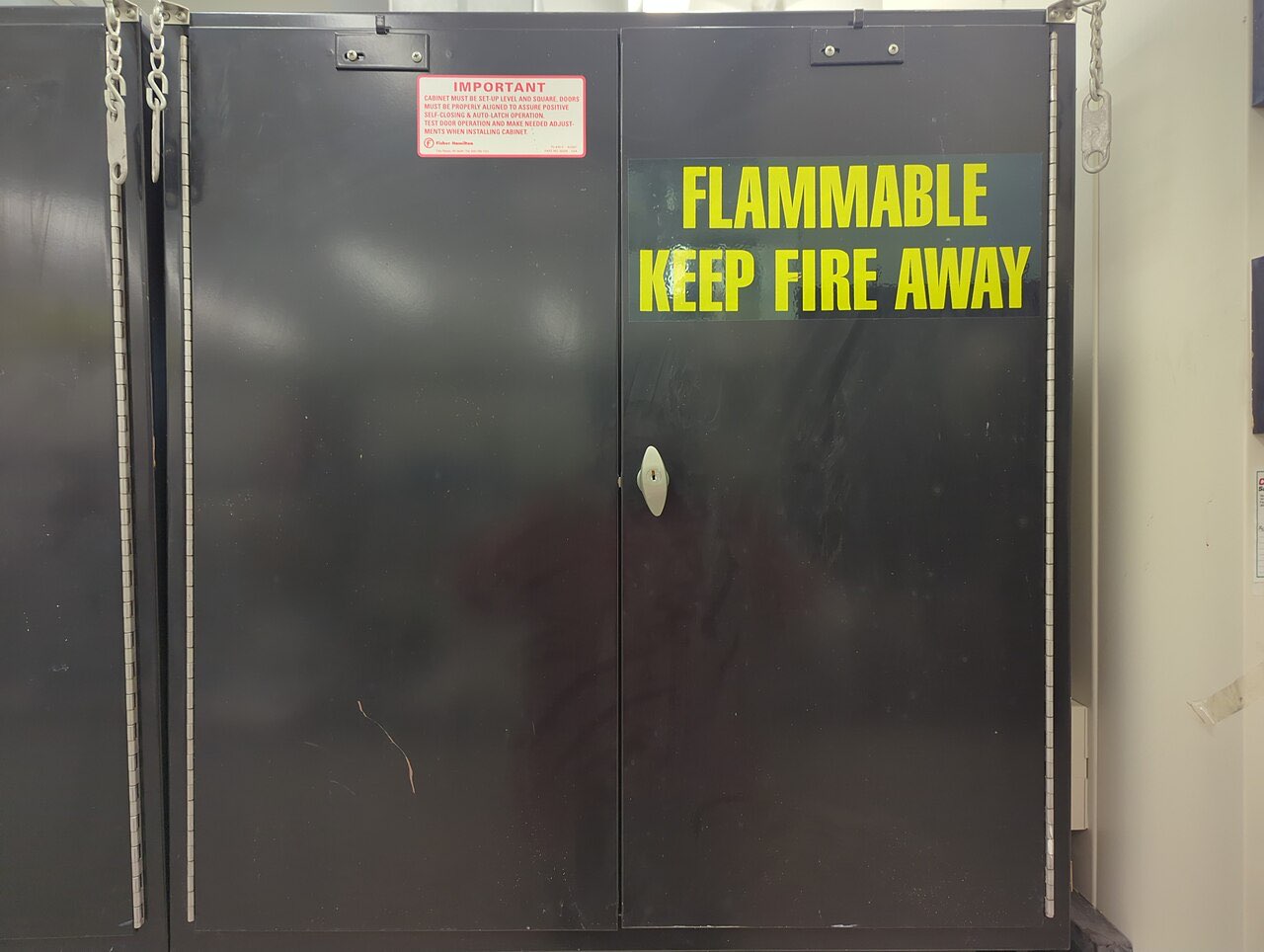
“Flammable - Keep Fire Away” in conspicuous lettering
Metal walls
At least No. 18 gauge, double walled, 1.5-inch air space
Joints
Riveted, welded or equally tight
Door
Three-point lock
Sill
Raised at least 2 inches above the cabinet bottom, so spills stay inside
Wood option
At least 1-inch approved plywood, rabbetted joints screwed in two directions
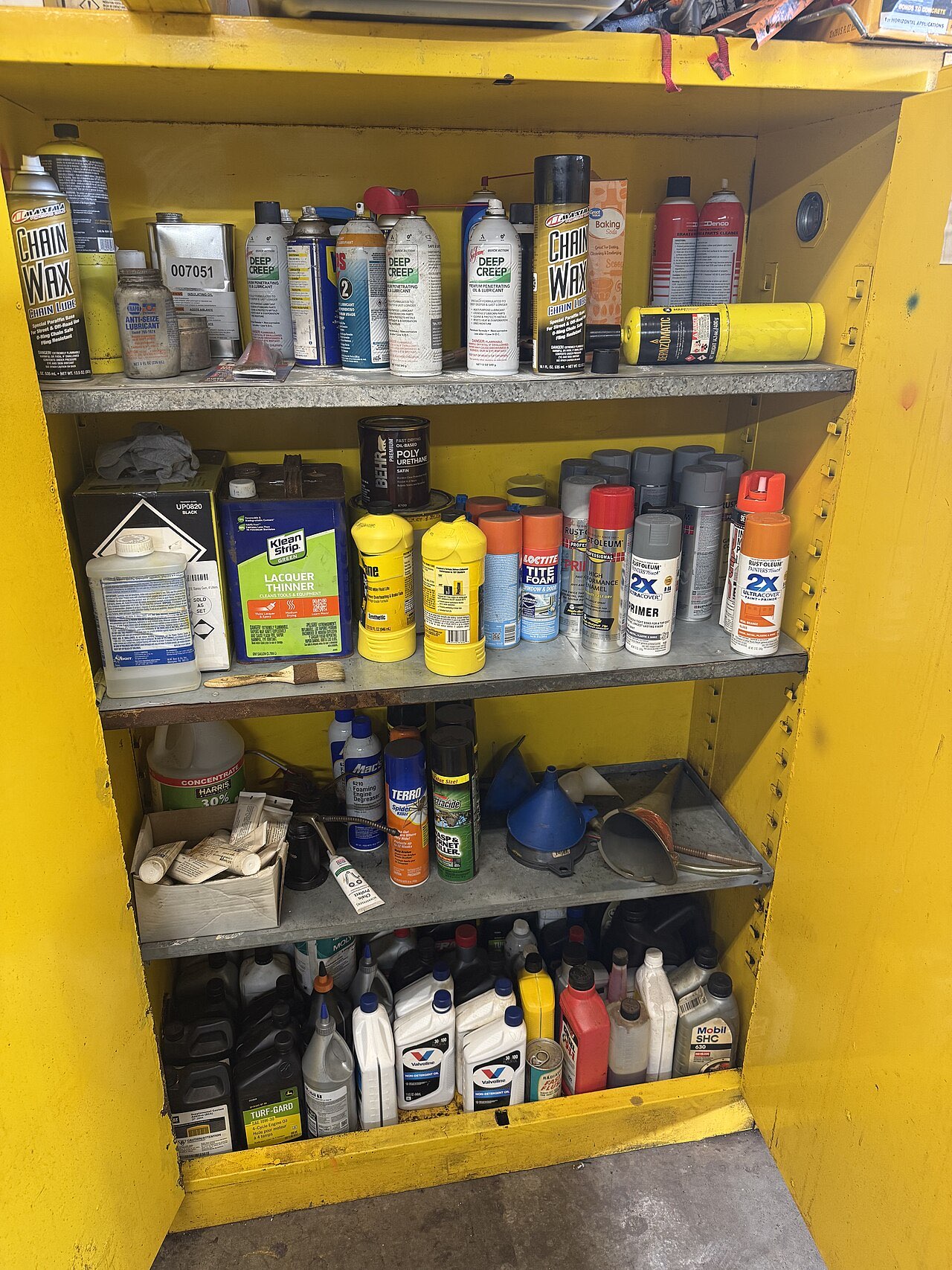
A yellow safety cabinet in a shop holding aerosols, thinners and oils, the mix many garages store. Photo: Mreid41 / CC0, via Wikimedia Commons
Branded cabinets add independent approval. Distributor listings for Justrite’s Sure-Grip EX line say the cabinets are FM approved and meet OSHA and NFPA 30, and describe 18-gauge double-wall welded steel with a 1.5-inch air space, a three-point latch and a 2-inch leakproof sump. A painted steel locker or a standard garage cabinet has none of this, even if it locks. Our garage cabinets vs open shelving guide covers ordinary cabinets; they are for dust and security, not fire.
Self-closing doors are an option worth paying for if the cabinet will sit where a fire could start nearby. Justrite’s self-closing 30-gallon versions close and latch on their own when fusible links melt at 165 F, per distributor listings. Manual doors only protect the contents if someone shut them.
Sizes that fit a garage
Cabinets are sold by the gallons of liquid in containers they are rated to hold. Common sizes for a home garage:
Cabinet (per distributor listings)
Capacity
Exterior W x H x D
Shelves / doors
Justrite Sure-Grip EX Compac 891200
12 gal
23.25 x 35 x 18 in
1 shelf, 1 manual door
Eagle 1925X (manual) / 1924X (self-close)
12 gal
23.25 x 35 x 18 in
1 door
Justrite Sure-Grip EX 893000
30 gal
43 x 44 x 18 in
1 shelf, 2 manual doors
Justrite 893020 / 893021
30 gal
43 x 44 x 18 in
Self-closing doors
Check current prices with an industrial supplier; these are commercial products and are not cheap. We could not confirm an Amazon listing for any of them, so none is linked. Confirm dimensions on the maker’s spec sheet for the exact model number, because distributor listings disagree on details such as shipping weight.
Two sizing notes. First, a 12-gallon cabinet suits quarts, gallons and aerosols; before buying one for fuel cans, check the interior (about 30.5 x 20 x 14.6 inches on the Compac, per distributor listings) against your can’s footprint and height with the shelf in place. Second, an empty 30-gallon cabinet is heavy. Plan its spot before delivery, keep it on the floor, and do not hang it from a wall rail.
Gasoline: where it should actually go
Fuel is the item that makes people search for a cabinet, and it is the one where the location matters more than the box:
Use approved containers. The fire-authority guidance above says listed containers of 5 gallons or less, caps tight, both spout and vent sealed.
Keep it out of the house and, where your fire code allows, consider a detached shed instead of an attached garage.
Keep it away from ignition sources. The same pamphlet names water heaters, electric motors and car engines. Gas-fired water heaters and furnaces in garages are the classic hazard; vapor is heavier than air and travels along the floor.
Keep only what you use. A season’s worth of mower and generator fuel, not a stockpile.
Fill cans on the ground, never in a trunk or truck bed.
Keep a fire extinguisher near the garage door. The pamphlet suggests at least a 2A:10-BC rating where flammable liquids are stored.
A safety cabinet is a reasonable home for fuel cans if your fire department agrees, but it does not cancel any of the points above. Follow the cabinet maker’s manual on venting and grounding, and ask your fire department if you are unsure; we have not stated a venting rule here because the NFPA 30 text is not freely available to check.
What can stay on open shelving
Most garage chemicals are not Category 1 to 3 flammable liquids. Latex paint, most cleaners, fertilizer, bagged ice melt and motor oil can live on ordinary steel shelving if you follow the EPA’s household hazardous waste basics (EPA): keep products in their original containers with labels on, never in food containers, follow the label’s storage directions, never mix leftovers, and take what you no longer need to a household hazardous waste collection.
Shelving setup that helps:
Bottom shelf for liquids. A drip from a low shelf hits the floor, not the box below. Cans are dense; low is also better for stability.
Solid deck or a tray. Wire decks let a leak run through every shelf below. A one-piece steel deck or a plastic boot tray contains it.
Separate by type. Keep pool chemicals, fertilizers and fuels apart; read the labels for incompatibilities.
Away from heat and children. Nothing on the shelf beside the water heater, and nothing a child can reach without a latch.
Anchor the unit. Shelving loaded with cans is top-heavy if you put them high; anchor it to the wall either way.
Featured (disclosed relationship): Lionhon and REIBII shelving for paint and non-flammable liquids
Both brands pay a bonus commission on the units below, which are picked on published specs for one job: a solid-deck shelf for paint, cleaners and oil. Neither is for gasoline, thinners, solvents or other flammable liquids beyond small household amounts; those belong in approved containers and, where advised, a safety cabinet. Neither listing names a test standard, and we could not confirm anchor hardware in either box.
Lionhon 59 x 23 x 67-inch 4-tier ($125.99): one-piece steel panel decks; listed at up to 1,125 lb per shelf, evenly distributed. Not for: a narrow wall (it is 59 inches wide).
Price as of November 18, 2026, 4:08 PM ET. Prices and availability are accurate as of the date/time indicated and are subject to change. Any price and availability information displayed on Amazon.com at the time of purchase will apply to the purchase of this product.
REIBII 48.2 x 24.5 x 72-inch 5-tier ($175.98): solid steel grid decks; listed at 602 lb per shelf. Not for: anyone who wants a fully flat sheet-metal deck; put a tray under liquids.
Price as of November 18, 2026, 4:08 PM ET. Prices and availability are accurate as of the date/time indicated and are subject to change. Any price and availability information displayed on Amazon.com at the time of purchase will apply to the purchase of this product.
Approved cans, 5 gal or less, away from ignition sources; shed or safety cabinet if your fire department advises
Paint thinner, mineral spirits, lacquer, solvent-based stain, aerosols
Safety cabinet if you keep more than a few containers; otherwise low shelf, cool, away from heat
Latex paint, cleaners, motor oil, antifreeze
Bottom shelf of steel shelving with a solid deck or tray
Pool chemicals, fertilizer, pesticides
Separate shelf or cabinet, original containers, out of children’s reach
Propane cylinders
Follow the cylinder label and ask your fire department before keeping them in the garage
Leftovers you will not use
Household hazardous waste collection
Our garage storage ideas by zone guide shows where a chemical zone fits relative to the car, the door and the workbench.
Bottom line
A real flammable safety cabinet is defined by its construction: 18-gauge double walls with an air gap, a three-point latch, a raised sill, a warning label and, on branded units, FM approval. It earns its place in a garage shop or anywhere you keep several gallons of solvents and fuel. For most homes, the first steps are cheaper: ask the fire department what fuel you may keep, store it in approved cans away from the water heater, put paint and cleaners on the bottom shelf of steel shelving with a solid deck, and dispose of what you no longer need.
Frequently asked questions
Do I need a flammable storage cabinet in my home garage?
Not usually by law. The OSHA cabinet rules apply to workplaces, and home garages fall under your local fire code, which mainly limits how much fuel you keep and in what containers. A cabinet is worth it if you keep several gallons of solvents, thinners, aerosols or fuel indoors, or run a shop out of the garage. For a can of gas and some latex paint, a good container and a sensible shelf location matter more.
Can I store gasoline in a flammable cabinet in an attached garage?
Check with your fire department first. The Unified Fire Authority's home pamphlet, citing the International Fire Code, says to keep gasoline only in approved containers of 5 gallons or less, in the garage or a shed and never in the house, and away from water heaters and other ignition sources. Some towns set lower limits than the IFC. A cabinet slows heat from a fire reaching the cans; it does not make vapor near a pilot light safe.
What makes a cabinet a real flammable safety cabinet?
Under OSHA 1910.106, a metal cabinet built to the rule has at least 18-gauge steel top, bottom, sides and door, double walls with a 1.5-inch air space, riveted or welded joints, a three-point door lock, a door sill raised at least 2 inches, and the label 'Flammable - Keep Fire Away'. Most branded cabinets also carry FM approval. A painted steel locker without those features is not a safety cabinet.
How many gallons can a flammable cabinet hold?
OSHA caps a single cabinet at 60 gallons of the more volatile Category 1 to 3 liquids or 120 gallons of Category 4. Cabinets are sold by capacity: compact 12-gallon units are about 23 inches wide and 35 inches tall, and 30-gallon units about 43 inches wide and 44 inches tall. Your local fire code may allow far less than a cabinet can hold.
Where should I put paint and chemicals on open shelving?
Low, away from heat, and separated. Keep cans and bottles on the bottom shelf of a steel unit with a solid deck or a tray to catch drips, out of children's reach behind a latch if needed, and away from the water heater, furnace and car. Keep everything in its original labeled container, as the EPA advises, and never mix leftovers.
Free garage storage tools
Tote and Shelf Fit CalculatorPick your storage tote and shelf size to see how many fit per shelf, which way to face them, the overhang and how many units you need.
Plastic vs steel garage shelving compared on published load ratings, rust, moisture, depth and assembly, with spec-based steel picks from REIBII and Lionhon.
Best garage shelving, compared on published specs: per-shelf load ratings, 18 vs 24 inch depth for totes, wire vs MDF decks, and which unit suits which garage.
Corner garage shelving: how to set two units in an L, how big the blind corner is, corner wall shelves, anchoring at the corner and which unit depths to pair.