Corner Garage Shelving: L-Shaped Units and Corner Wall Shelves
In this guide
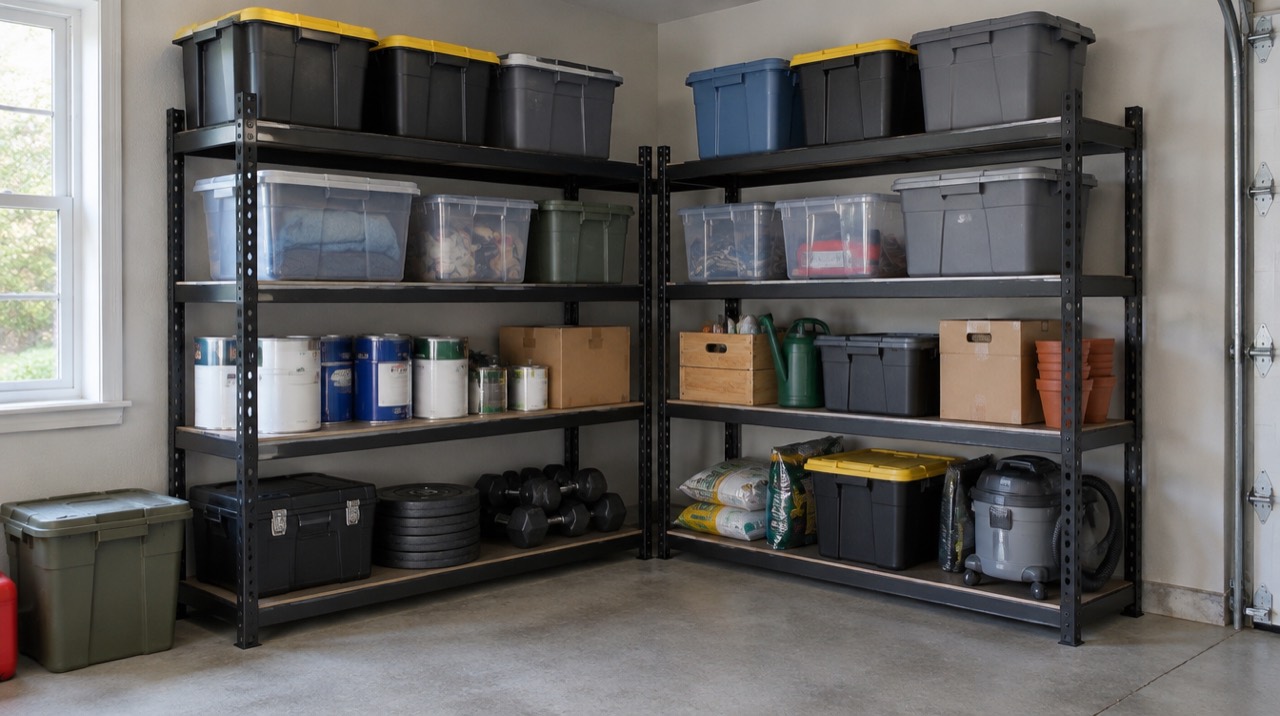
Short answer: for most garages the best corner shelving is two ordinary units set in an L, a deep one on the long wall and a shallow one on the short leg, each anchored to studs on its own. Expect a blind corner on every shelf, equal to one unit’s depth times the other’s; store rarely used things there or leave the corner open for long-handled tools. Higher up, two wall shelves can wrap the same corner. This guide is spec-based, built from the brands’ Amazon listings, manuals and tote makers’ dimensions, checked 2026-10-28. Disclosure: As an Amazon Associate I earn from qualifying purchases. Some brands featured below pay a bonus commission through Amazon Creator Connections. See /disclosure/.
Three ways to use a garage corner
| Approach | Best for | Watch out for |
|---|---|---|
| Two freestanding units in an L | Totes and bulk storage; most flexible | Blind corner on every shelf |
| Two wall shelves wrapping the corner | Keeping the floor clear for bikes, bins or a mower | Lower capacity; studs near the corner |
| Dedicated L-shaped or corner unit | Small items, tight corners | Usually shallow; one combined rating |
Dedicated L-shaped units exist, but the ones we found are shallow. One 5-tier wire unit listed at Walmart is 52.36 inches wide but only 13.78 inches deep, rated 1,400 lb in total, and can also be set up straight. That depth suits paint and small bins, not 27-gallon totes. We could not confirm an L-shaped unit on Amazon with a published per-shelf rating, so this guide focuses on the first two approaches.
The blind corner, measured
Put two units in an L and one unit’s corner end disappears behind the other. Reaching it means reaching past the second unit’s end. Its size is easy to work out: depth of the first unit times depth of the second.
| Unit A depth (into corner) | Unit B depth (in front) | Blind area per shelf |
|---|---|---|
| 24.5 in | 24.5 in | about 4.2 sq ft |
| 24.5 in | 16 in | about 2.7 sq ft |
| 16 in | 16 in | about 1.8 sq ft |
Our arithmetic. On REIBII’s 48.2-inch 5-tier, a 24.5-inch unit in front hides about half of each shelf; a 16-inch unit in front hides about a third. That is why pairing a deep unit with a shallow one is the usual advice: you keep tote depth on the main wall and lose less to the corner.
What to put in the blind corner: the things you touch once a year. Holiday bins, spare parts, archived paperwork in sealed totes. Put the item you reach for weekly at the open end of each unit, never in the corner.
The open-corner alternative
Instead of running unit A into the corner, stop both units short so the corner square is empty floor. You lose that square of shelving but gain a slot, the depth of one unit by the depth of the other, for brooms, rakes, a shop vac or a folded ladder standing upright. Our garden tool storage guide has ideas for long-handled tools.
Sizing the L
Measure both walls from the corner. For an L, the first unit needs its full width on wall 1, and the second needs the first unit’s depth plus its own width on wall 2. Example: a 48.2 x 24.5-inch unit on wall 1 and a 36 x 16-inch unit on wall 2 need 48.2 inches of wall 1 and about 60.5 inches of wall 2 (24.5 + 36), plus an inch or two of slack.
Check for corner obstacles before you buy: the door track and its spring hardware, an electrical panel, the water heater, a hose bib or a step down into the house. Keep whatever access space your local code and the appliance manual require in front of panels and water heaters, and do not block them with a blind corner. Our width guide and depth for totes guide cover the dimensions in detail.
Ratings at the joint
Two units in an L are still two units. Each has its own per-shelf rating, and nothing about the corner adds to either.
- Do not bridge. Laying a board across the corner from one unit’s shelf to the other’s puts a load on two beams neither maker designed for. We found no corner-connect kit in the REIBII or Lionhon listings we read; if a maker sells one for its own units, follow its instructions and ratings.
- Load the corner end lightly. The blind end is where you cannot see what is stacked; keep heavy items at the open, visible end of each shelf, near an upright.
- Use per-shelf figures, not totals. Some listings give only a total. Lionhon’s 36-inch unit, for example, lists 3,000 lb in total with no per-shelf figure, so plan conservatively on its shelves. Our weight capacity math guide explains why.
Anchoring in a corner
Corners are good for anchoring, because wall framing meets there and both units back onto solid wall. Still:
- Find studs on both walls; studs are usually 16 or 24 inches on center (Blaine, MN framing basics), and corner framing varies, so confirm with a stud finder and a small pilot hole.
- Anchor each unit separately to studs on its own wall, near the top. The CPSC’s Anchor It campaign recommends anchoring furniture with shelves, and Edsal’s assembly manual says to always secure its units to a wall.
- Do not rely on one unit wedging the other in place; either can be pulled forward on its own.
Our anchoring guide covers straps, brackets and cleats.
Corner wall shelves
Wall shelves can wrap a corner above a workbench, a chest freezer or the hood of a car. The same blind-corner rule applies, but wall shelves are shallower, so the hidden area is smaller.
- Mount the first shelf running into the corner; mount the second on the other wall with its end just clear of the first shelf’s front edge.
- Each shelf’s brackets or rail must still land on studs; a corner can push the last bracket off a stud, so plan bracket positions before you commit to shelf lengths.
- Keep them at the same height for a continuous L, or stagger them so tall items fit under one leg.
Our wall-mounted garage shelves guide compares wall systems and their ratings.
Featured picks


Freestanding L, deep plus shallow: the REIBII 48.2 x 24.5 x 72-inch 5-tier ($175.98) (602 lb per shelf, takes 27-gallon totes) on the long wall, with the Lionhon 36 x 16 x 71-inch 4-tier ($80.99) (3,000 lb total, no per-shelf figure) or the REIBII 32 x 17.1 x 72-inch 5-tier (410 lb per shelf, anti-tipping devices listed) on the short leg. Not for: corners where the short wall is under about 57 inches. Neither the REIBII 48.2-inch nor the Lionhon listing mentions anchor hardware, so buy a strap kit.
Price as of November 18, 2026, 4:08 PM ET. Prices and availability are accurate as of the date/time indicated and are subject to change. Any price and availability information displayed on Amazon.com at the time of purchase will apply to the purchase of this product.


Wall L above the floor: two packs of the FOFARY 48 x 20-inch wall shelving ($129.99), one per wall. The listing gives 300 lb without saying whether that is per shelf or for the pair, so plan on 150 lb per shelf; it mounts to wood studs, concrete or brick. For a shallower wrap over a bench, the FOFARY 24 x 12-inch shelf 2-pack ($39.99) lists 150 lb per shelf in its bullets, though other figures on the same listing conflict. Not for: heavy tote storage or metal-stud walls.
Price as of November 18, 2026, 4:08 PM ET. Prices and availability are accurate as of the date/time indicated and are subject to change. Any price and availability information displayed on Amazon.com at the time of purchase will apply to the purchase of this product.

A non-campaign alternative for wall corners is the FLEXIMOUNTS 2 x 6 ft wall shelf 2-pack ($135.99), rated 350 lb per unit, for wood studs, concrete or brick but not metal studs.
Price as of November 18, 2026, 4:08 PM ET. Prices and availability are accurate as of the date/time indicated and are subject to change. Any price and availability information displayed on Amazon.com at the time of purchase will apply to the purchase of this product.
Corner checklist
- Measure both walls from the corner and note obstacles.
- Choose deep on the long wall, shallow on the short leg.
- Work out the blind area and decide what lives there, or leave the corner open.
- Use per-shelf ratings; do not bridge between units.
- Anchor each unit to studs on its own wall.
- Keep weekly-use items at the open ends.
Frequently asked questions
How do I put garage shelving in a corner?
The usual way is two freestanding units in an L: one runs into the corner along the first wall, and the second sits along the other wall with its end against the first unit's front. Anchor each unit to studs separately. Wall shelves can make the same L higher up, with one shelf running into the corner and the other butting against its front edge.
What is the blind corner and how big is it?
It is the end of the first unit's shelves that the second unit hides. Its size is the first unit's depth times the second unit's depth: two 24.5-inch-deep units hide about 4 square feet on every shelf, while pairing a 24.5-inch unit with a 16-inch unit cuts it to about 2.7 square feet. Use it for things you rarely need, or leave the corner open instead.
Are L-shaped garage shelving units worth it?
They solve the joint neatly but tend to be shallow; one L-shaped wire unit we found listed at Walmart is under 14 inches deep, too shallow for 27-gallon totes. Two standard units in an L give you deeper shelves, separate per-shelf ratings and the option to move them later.
Can I connect two shelving units at the corner?
Only with hardware the maker provides for it. We did not find a corner-connect kit in the REIBII or Lionhon listings we read. Anchor each unit to the wall on its own; do not bridge a board between two units, because neither unit's rating covers a load spanning the gap.
What depth works best for corner shelving?
Pair a deep unit with a shallow one. A 24-inch-deep unit on the main wall takes 27-gallon totes, and a 16-inch-deep unit on the short leg shrinks the blind corner and keeps the walkway clear. Two deep units waste the most corner space.
Keep planning
- Plastic vs Steel Garage Shelving
Plastic vs steel garage shelving compared on published load ratings, rust, moisture, depth and assembly, with spec-based steel picks from REIBII and Lionhon.
Updated Nov 2026 - Best Garage Shelving: Heavy-Duty Picks on Published Specs
Best garage shelving, compared on published specs: per-shelf load ratings, 18 vs 24 inch depth for totes, wire vs MDF decks, and which unit suits which garage.
Updated Oct 2026 - Flammable Storage Cabinets for Gas, Paint and Chemicals in a Garage
What a flammable storage cabinet does in a home garage: OSHA construction rules, gallon capacities, where gasoline should live, and what open shelving can hold.
Updated Oct 2026