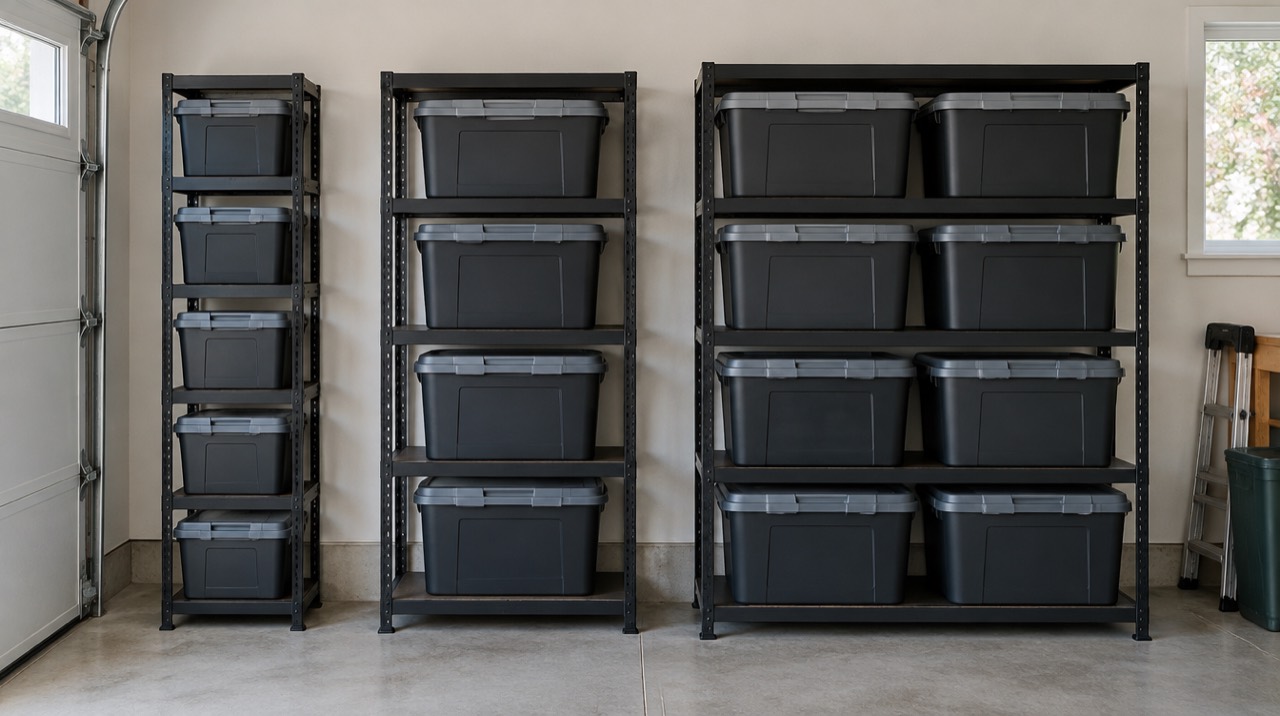
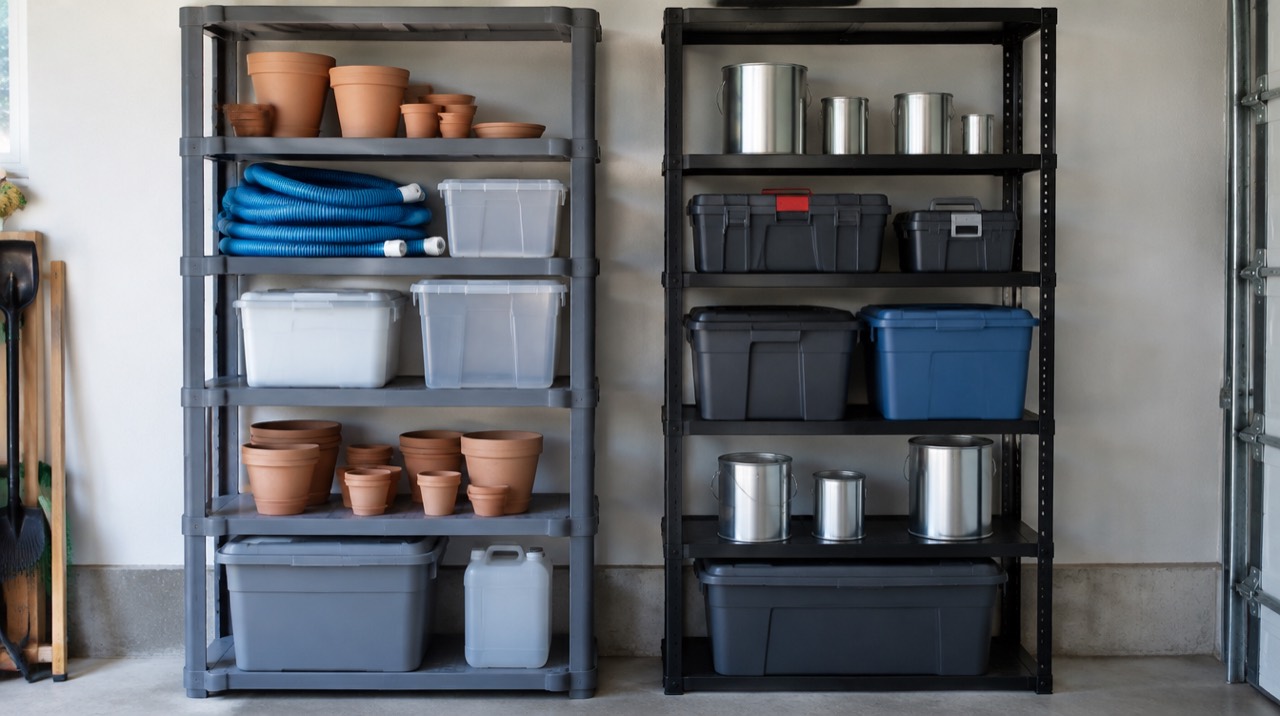
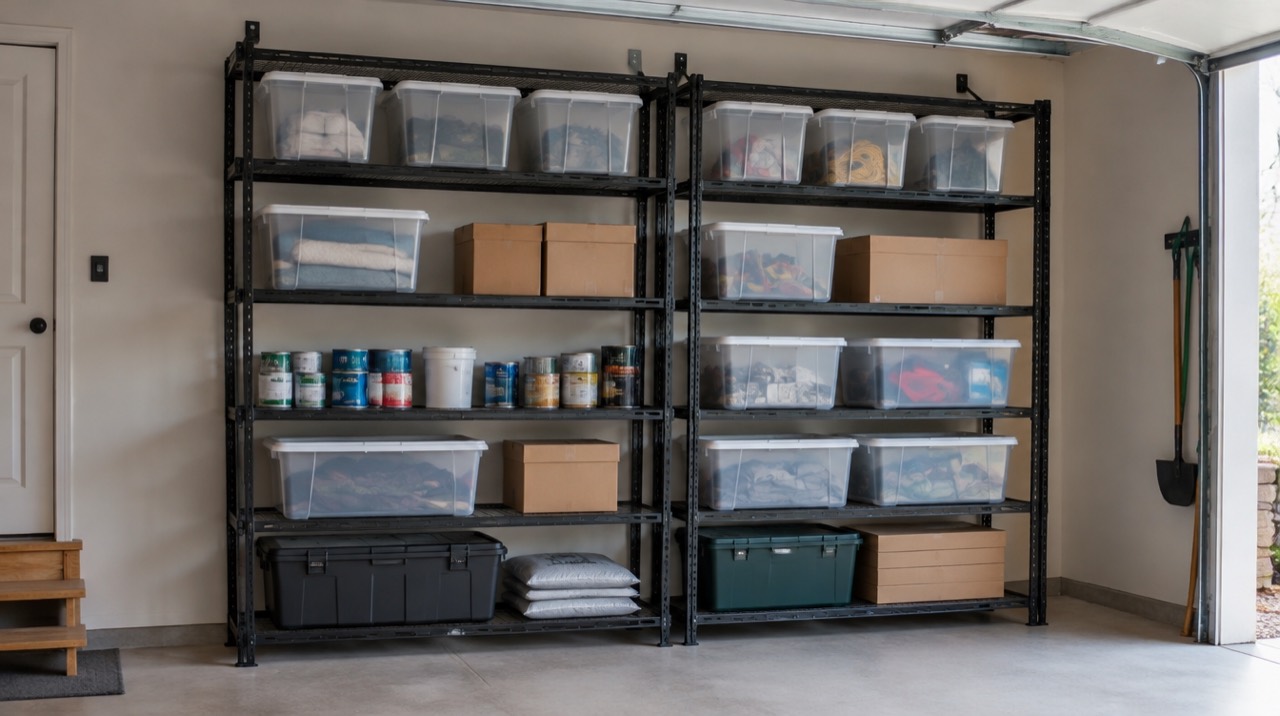
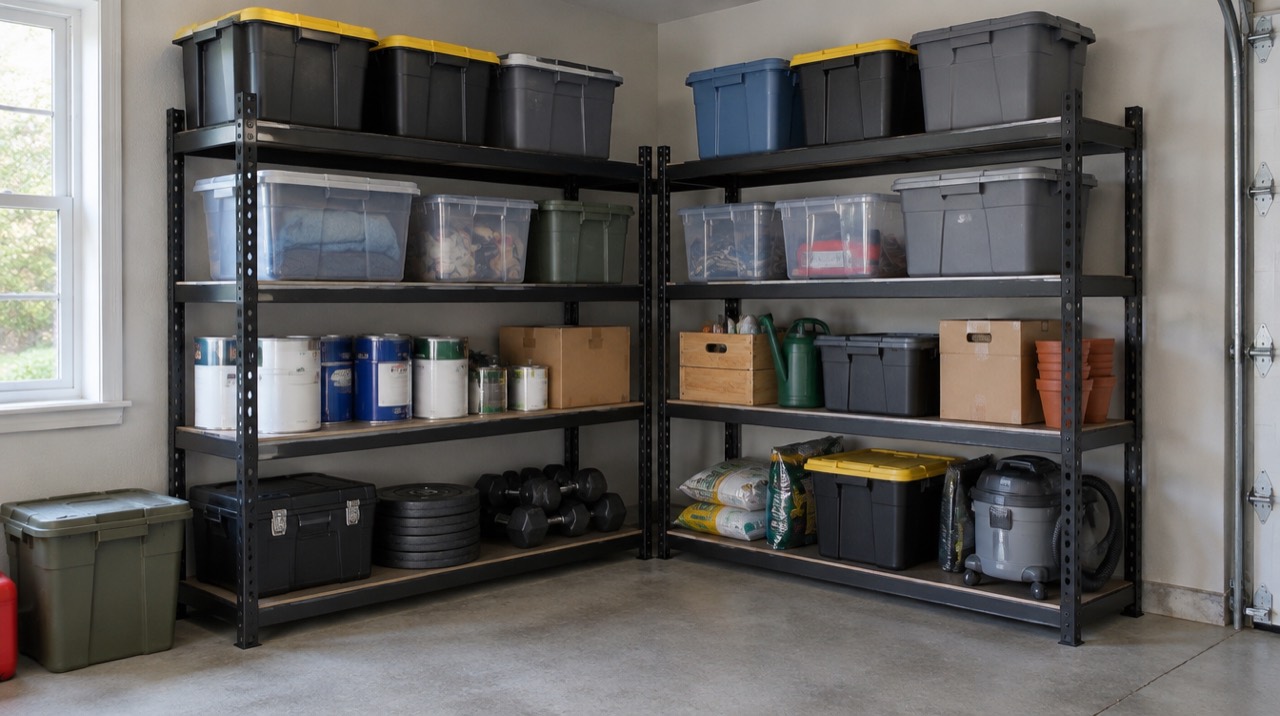
Short answer: pick the width from what goes on the shelf. For 27-gallon totes, 60 inches is the sweet spot (two per shelf, long side out); 48 inches is best for 18-gallon totes (three per shelf); 36 inches fits narrow gaps, paint and tools; and a 6-foot wall is usually filled with a 68-inch-class unit or two 36-inch units. Wider is not automatically weaker on paper, but check each unit’s per-shelf rating, not the total. This guide is spec-based: unit dimensions and ratings come from the brands’ Amazon listings and manuals, checked 2026-10-28, and tote sizes from the tote makers. Disclosure: As an Amazon Associate I earn from qualifying purchases. Some brands featured below pay a bonus commission through Amazon Creator Connections. See /disclosure/.
Totes per shelf by width
The tote is the usual unit of garage storage, so start there. Outside rim sizes, from the makers:
Sterilite 27-gallon Industrial: 28 1/2 x 19 5/8 in (Sterilite). The HDX 27-gallon Tough Tote is almost identical at about 28.6 x 19.6 in.
Sterilite 27-gallon Stacker: 25 3/4 x 18 3/8 in.
Rubbermaid Roughneck 18-gallon: about 23.9 x 15.9 in.
Shelf width
27-gal, long side out (28.5 in)
27-gal, short side out (19.6 in, needs 28.5 in depth)
18-gal Roughneck, short side out (15.9 in, needs 24 in depth)
36 in
1
1
2
48 in
1
2 (overhangs a 24 in shelf by about 4.5 in)
3
60 in
2
3 (overhang as above)
3
68 to 72 in
2
3 (overhang as above)
4
Our arithmetic from the published rim sizes. Shelf width is the overall width; the clear space between uprights is a little less, so measure it before buying if a fit is tight. Totes are smaller at the base than the rim, which helps a little with overhang.
The table shows why 48 and 60 inches dominate garage shelving: 48 inches suits 18-gallon totes, 60 inches suits 27-gallon totes, and anything in between leaves a gap. Depth matters just as much; our shelving depth for totes guide covers 16, 18 and 24-inch decks.
Published units by width
Specs from each Amazon listing (checked 2026-10-28) or manual. Per-shelf figures are the makers’ own claims for evenly distributed loads; none names a test standard.
Price as of November 18, 2026, 4:08 PM ET. Prices and availability are accurate as of the date/time indicated and are subject to change. Any price and availability information displayed on Amazon.com at the time of purchase will apply to the purchase of this product.
Where the per-shelf figure is “not stated”, do not divide the total by the number of shelves and treat that as a rating; ask the seller or plan conservatively. Our weight capacity math guide explains why totals overstate what one shelf can take.
Does width change capacity?
Physically, yes: a longer beam carrying the same load bends more than a short one, and the center of a long shelf deflects most. Makers handle this by using deeper beams, adding ribs or center supports, or simply publishing a lower rating. On paper, though, the published numbers do not fall neatly with width:
REIBII’s 32-inch unit lists 410 lb per shelf; its 68.3-inch wire rack lists 1,272 lb, with four support bars per tier.
Lionhon’s 59-inch unit lists up to 1,125 lb per shelf on a one-piece panel with 8 ribs.
Edsal’s UR-series manual, which covers 30, 36 and 48-inch models, gives one 800 lb per-shelf rating for the series, evenly distributed.
Dividing the per-shelf figure by width gives a rough “pounds per foot” comparison: about 150 lb per foot for the REIBII 32 and 48.2-inch units, about 120 lb for the Seville 60-inch, and about 225 to 230 lb for the Lionhon 59-inch and REIBII 68.3-inch. That is our arithmetic on the makers’ claims, not a test. The practical rules are the same at every width: spread weight evenly, put the heaviest items near the uprights rather than mid-span, and keep a full tote of tools off the center of a long particleboard deck.
Width and anchoring: count the studs
Every tall unit should be anchored to the wall; the CPSC’s Anchor It campaign recommends it for any furniture with shelves, and Edsal’s manual says to always secure units to a wall. Anchors should go into studs, which are usually 16 or 24 inches apart on center (Blaine, MN framing basics).
Unit width
Studs crossed at 16 in o.c.
Studs crossed at 24 in o.c.
36 in
2, sometimes 3
1 or 2
48 in
3
2
60 in
3 or 4
2 or 3
68 to 72 in
4 or 5
3
A 36-inch unit on a 24-inch stud layout may cross only one stud, so you may need a horizontal cleat screwed across two studs to anchor both uprights. Our anchoring guide covers straps, brackets and cleats.
Filling a 6-foot or longer wall
You have three ways to cover 72 inches or more:
One wide unit. The REIBII 68.3-inch rack is the widest unit here with a published per-shelf figure. One frame, four uprights, no gap in the middle.
Two 36-inch units. Two separate ratings and the option to move one later, but a double upright in the middle and only one 27-gallon tote per shelf on each.
A 48 plus a 24 to 28-inch unit. Useful when a door or water heater breaks the wall; the narrow unit takes paint and small bins.
For walls over 8 feet, two 48-inch units (96 inches) or a 60 plus a 36 are the common combinations. Leave at least an inch or two between units and at each end for assembly and leveling.
Which width to buy
Featured (disclosed relationship): REIBII and Lionhon
Both brands pay a bonus commission on the units in this guide, so the picks below are made on published width, depth and per-shelf specs alone. They are not for: buyers who need a published test standard (neither brand names one), or anyone who wants anchor hardware guaranteed in the box (only some REIBII listings mention anti-tip kits).
27-gallon totes, two per shelf: the Lionhon 59 x 23 x 67-inch 4-tier ($125.99), up to 1,125 lb per shelf per the listing. Not for: walls under about 62 inches or anyone wanting five tiers.
Price as of November 18, 2026, 4:08 PM ET. Prices and availability are accurate as of the date/time indicated and are subject to change. Any price and availability information displayed on Amazon.com at the time of purchase will apply to the purchase of this product.
18-gallon totes, three per shelf: the REIBII 48.2 x 24.5 x 72-inch 5-tier ($175.98), 602 lb per shelf. Not for: two 27-gallon totes per shelf without overhang.
Price as of November 18, 2026, 4:08 PM ET. Prices and availability are accurate as of the date/time indicated and are subject to change. Any price and availability information displayed on Amazon.com at the time of purchase will apply to the purchase of this product.
A 6-foot wall in one unit: the REIBII 68.3 x 23.4 x 72-inch wire rack ($169.99), 1,272 lb per shelf, two anti-tip kits listed. Not for: small loose items without a shelf liner.
Price as of November 18, 2026, 4:08 PM ET. Prices and availability are accurate as of the date/time indicated and are subject to change. Any price and availability information displayed on Amazon.com at the time of purchase will apply to the purchase of this product.
Price as of November 18, 2026, 4:08 PM ET. Prices and availability are accurate as of the date/time indicated and are subject to change. Any price and availability information displayed on Amazon.com at the time of purchase will apply to the purchase of this product.
Measuring checklist
Measure the wall, then subtract an inch or two at each end.
Note doors, outlets, switches, the water heater and the door track.
Decide on tote size and orientation, then read the width from the table above.
Check the depth against the tote’s other dimension.
Compare per-shelf ratings, not totals.
Mark the studs and confirm at least two anchor points will land on them.
Frequently asked questions
What width garage shelving fits two 27-gallon totes?
About 60 inches. A Sterilite 27-gallon Industrial tote is 28 1/2 x 19 5/8 inches at the rim, so two side by side with the long side facing out need about 57 inches plus a little clearance. A 59 or 60-inch unit or the 68-inch class does it; a 48-inch shelf holds one that way, or two turned sideways if you accept about 4 inches of overhang on a 24-inch-deep shelf.
Is 48-inch or 36-inch garage shelving better?
For totes, 48 inches is the more useful width: it takes three 18-gallon Roughneck-size totes short side forward on a 24-inch-deep shelf, against two on a 36-inch shelf. A 36-inch unit suits narrow wall gaps, paint and tools, and on a 16-inch stud layout it may only reach two studs for anchoring.
Do wider shelves hold less weight?
Not necessarily on paper. Published per-shelf ratings do not fall neatly with width: REIBII lists 410 lb per shelf on a 32-inch unit and 1,272 lb on a 68.3-inch rack, and Edsal's UR-series manual gives one 800 lb per-shelf rating across its 30, 36 and 48-inch models. A longer beam does bend more under the same load, so compare each unit's per-shelf figure and keep heavy items near the uprights.
Is there 72-inch-wide garage shelving?
Yes, but single 72-inch units are less common than 48 and 60-inch ones. Many people fill a 6-foot wall with a 68-inch-class unit or two 36-inch units side by side. Two units give you two separate ratings and four uprights, but leave a double upright in the middle.
How much wall do I need beyond the shelf width?
Allow at least an inch or two either side for assembly and leveling, more if a door, outlet or water heater is nearby. Also check that at least two of the unit's anchor points can land on studs; at 16 inches on center a 48-inch unit typically spans three studs.
Free garage storage tools
Tote and Shelf Fit CalculatorPick your storage tote and shelf size to see how many fit per shelf, which way to face them, the overhang and how many units you need.
Plastic vs steel garage shelving compared on published load ratings, rust, moisture, depth and assembly, with spec-based steel picks from REIBII and Lionhon.
Best garage shelving, compared on published specs: per-shelf load ratings, 18 vs 24 inch depth for totes, wire vs MDF decks, and which unit suits which garage.
Corner garage shelving: how to set two units in an L, how big the blind corner is, corner wall shelves, anchoring at the corner and which unit depths to pair.