Tire Storage Racks and Shelving for Garages
In this guide
Store a set of seasonal tires off the floor, out of the sun, and away from anything that makes ozone or fumes. Then pick the hardware by format: a folding wall tire rack for one set of four stored upright, or a deep, heavy-duty shelving unit for mounted wheel-and-tire sets stored flat, two sets, or tires plus other heavy gear. The numbers that decide the shelf are your tire’s diameter and width, which you can work out from the size on the sidewall, not its weight. This is a spec-based guide: we compare published listings (checked 2026-10-28) and the tire industry’s storage bulletin, not our own installs. Disclosure: As an Amazon Associate I earn from qualifying purchases. Some brands featured below (Lionhon, REIBII) pay a bonus commission through Amazon Creator Connections. See /disclosure/.
The storage rules that apply to any rack
The U.S. Tire Manufacturers Association’s tire storage bulletin is the most useful single reference, and most of it applies directly to a garage:
- Clean, dry, well ventilated, with little circulating air, in mild temperatures, shaded or dark.
- Raised off the floor, on a pallet or storage rack. It adds that pallets should have a flat, smooth surface rather than a grated one, because a grated surface can leave an indentation on a tire stored on it for a long time.
- Unmounted tires sidewall to sidewall, either stacked flat (“stovepipe”) or racked, without over-stacking.
- No petroleum products or solvents. Do not store tires against gasoline cans, oil or solvent shelves.
- No ozone sources. It names electric motors, battery chargers, generators and welding equipment. In a garage, that means not beside the freezer compressor, the trickle charger or the air compressor.
- No direct sun and no extreme heat or cold.
Before mounting stored tires, the bulletin says to have them inspected, and it notes that the last four digits of the DOT tire identification number are the week and year of manufacture.
Know your tire’s size before you buy a rack
Every tire’s dimensions are in its size code. Take 225/65R17, a common crossover size:
| Part of the code | Meaning | Value (our arithmetic) |
|---|---|---|
| 225 | Section width in mm | 225 mm = about 8.9 in wide |
| 65 | Sidewall height as % of width | 65% of 225 = 146 mm = about 5.75 in |
| R17 | Wheel diameter in inches | 17 in |
| Overall diameter | Wheel + 2 sidewalls | 17 + 2 x 5.75 = about 28.5 in tall |
A light-truck size such as 275/65R18 works out to about 10.8 inches wide and 32 inches tall. Do this once for your own tires; it tells you everything below.
Weight. The USTMA’s scrap tire report raised its average weight for a passenger or light-truck tire to 25 lb, reflecting the shift to SUV and truck tires. A tire on a wheel is heavier; steel and large alloy wheels add a lot. Weigh one on a bathroom scale (hold it, subtract your own weight) and multiply by four. Even generous figures for a mounted set sit well below the per-shelf rating of the shelving units here.
Option 1: a folding wall tire rack
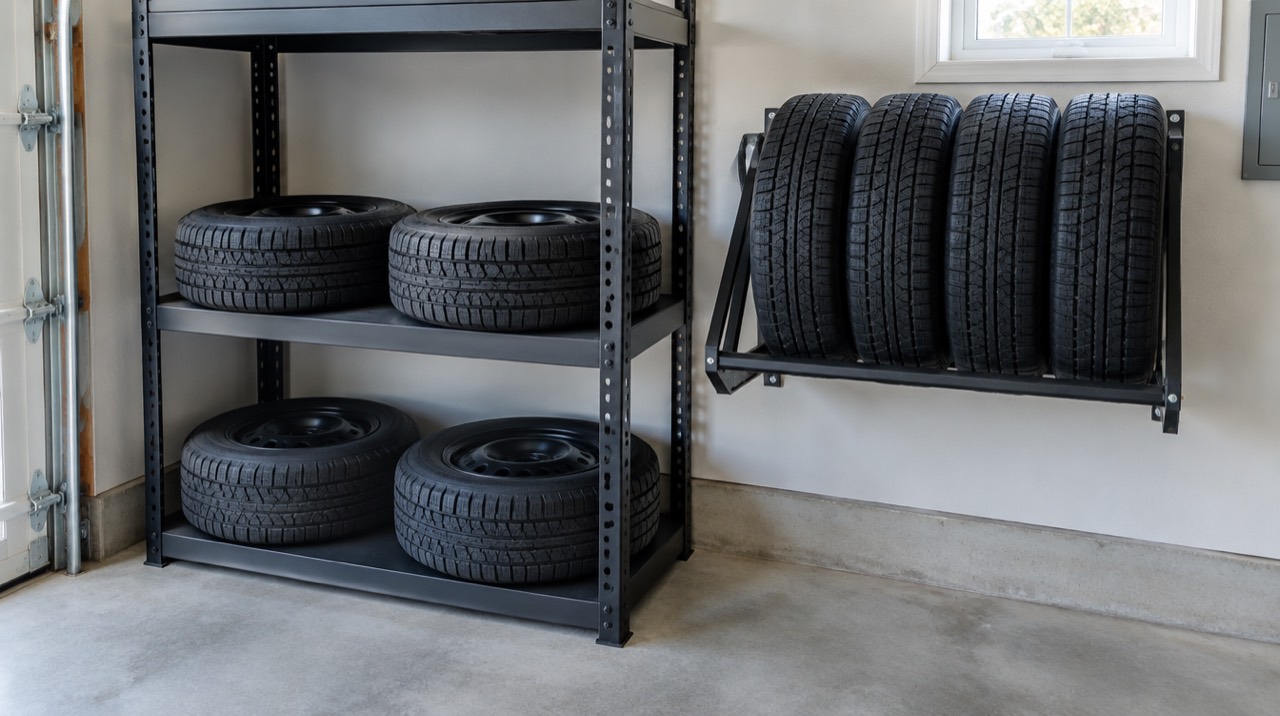
A wall tire rack is two arms and a cradle that bolt to the wall and hold tires upright in a row. When empty, most fold flat.

The MaxxHaul 70489 adjustable wall-mount folding tire rack ($47.55) is a typical example: the listing gives a 300 lb capacity, a width that adjusts from 32 to 48 inches, and room for four tires. A version of the same model number sold in Canada lists a 30-inch maximum tire diameter, which is worth checking against your arithmetic above if you run large truck tires.
Price as of November 18, 2026, 4:08 PM ET. Prices and availability are accurate as of the date/time indicated and are subject to change. Any price and availability information displayed on Amazon.com at the time of purchase will apply to the purchase of this product.
Width check. Four 8.9-inch tires need about 36 inches; four 10.8-inch light-truck tires need about 43 inches. Both fit a rack that extends to 48 inches.
Who it suits: one set of four tires, a garage where floor space is precious, and a wall with studs where the rack can go.
What to watch:
- Mount into studs with lag screws sized for the rack. The load hangs out from the wall, so the top fasteners are pulled outward; drywall alone will not do. On a block wall, read our guide to mounting shelves on concrete block first.
- Height. Lifting a 50 lb wheel above shoulder height is awkward and risky. Mount it low enough to roll tires up onto it.
- Clearance. A row of tires sticks out roughly a tire’s width plus the cradle from the wall. Keep it outside the car-door swing.
Option 2: heavy-duty shelving
A freestanding steel shelving unit handles more than one set and more than one format: mounted sets flat on the lower shelves, bins and fluids (kept on a different unit from the tires, per the solvent rule) elsewhere. The two decisions are width and depth.
Width. Two tires lying flat side by side need two diameters of width: about 57 inches for 28.5-inch tires. A 48-inch-wide shelf takes one tire flat, or about five tires standing upright in a row.
Depth. Lying flat, a 28.5-inch tire on a 23 to 24.5-inch-deep shelf overhangs by 4 to 6 inches. On a solid shelf that is fine for most tires; keep the overhang toward the front and centered.
Height between shelves. Two tires stacked flat stand about 18 inches (2 x 8.9 in). Upright, you need clear height greater than the diameter, about 29 to 33 inches, which usually means removing a shelf level.

Check the current price of the Lionhon 59 x 23 x 67 in shelving on Amazon.
$125.99Price as of November 18, 2026, 4:08 PM ET. Prices and availability are accurate as of the date/time indicated and are subject to change. Any price and availability information displayed on Amazon.com at the time of purchase will apply to the purchase of this product.

Check the current price of the REIBII 48.2 x 24.5 x 72 in shelving on Amazon.
$175.98Price as of November 18, 2026, 4:08 PM ET. Prices and availability are accurate as of the date/time indicated and are subject to change. Any price and availability information displayed on Amazon.com at the time of purchase will apply to the purchase of this product.

About wire decks. Some heavy units, such as the REIBII 5088 lb 68.3-inch wire rack ($169.99) (1,272 lb per shelf per its listing), use wire-grid decks. The capacity is plenty, and 68 inches of width takes two tires flat. But the USTMA’s caution about grated surfaces suggests putting a sheet of plywood or a solid liner on a wire deck before storing tires on it for a whole season.
Price as of November 18, 2026, 4:08 PM ET. Prices and availability are accurate as of the date/time indicated and are subject to change. Any price and availability information displayed on Amazon.com at the time of purchase will apply to the purchase of this product.
Comparison
| Option (listing checked 2026-10-28) | Size | Rated load | Tires lying flat per shelf (28.5 in tire) | Tires upright | Floor space |
|---|---|---|---|---|---|
| MaxxHaul 70489 wall rack | 32 to 48 in wide, adjustable | 300 lb total | n/a | 4 | None |
| Lionhon 4-tier | 59 x 23 x 67 in | 1,125 lb per shelf | 2 | About 6 (shelf removed) | 59 x 23 in |
| REIBII 5-tier | 48.2 x 24.5 x 72 in | 602 lb per shelf | 1 | About 5 (shelf removed) | 48 x 24.5 in |
| REIBII 5088 lb wire rack | 68.3 x 23.4 x 72 in | 1,272 lb per shelf | 2 (add a solid liner) | About 7 (shelf removed) | 68 x 23.4 in |
Tire counts are our arithmetic from the listed widths and the example tire; check the current price and your own tire size before buying.
Mounted vs unmounted, flat vs upright
Guidance differs by source, so here is how it breaks down:
- USTMA: unmounted tires stacked flat or racked sidewall to sidewall, not over-stacked.
- Volvo (owner support page): complete wheels hung or laid on their sides; unmounted tires laid flat or upright, but not hung.
- Michelin (as reported by the Globe and Mail): mounted tires hung or stacked flat, unmounted tires upright.
A practical reading for a garage: store mounted sets flat in stacks of two on a shelf, or hang them on hardware rated for wheels. Store unmounted tires upright in a wall rack, or flat in short stacks. If your tire maker publishes storage guidance for your specific tire, that wins.
Placement in the garage
- Away from the water heater, furnace, chest freezer, battery charger and compressor. That covers both the heat and the ozone rules.
- Away from the fuel and oil shelf. Keep a separate shelf or unit for fluids.
- Out of direct sun from a garage-door window or side window.
- Low. Mounted wheels are heavy; bottom and second shelves only. The lowest shelf should still be off the floor.
- Anchored. A tall unit loaded with wheels is top-heavy if you put them high. See how to anchor garage shelving to the wall.
- Covered, loosely. A breathable cover or tire bags keep dust off; the USTMA’s outdoor advice is opaque and vented rather than sealed.
Bottom line
Work out your tire’s diameter and width from the size code, then choose: a 300 lb folding wall rack for one set stored upright, or a wide heavy-duty unit with solid shelves for mounted sets stored flat. Keep tires low, off the floor, away from chargers, motors and fuel, and out of the sun. For choosing heavy shelving more broadly, see our best garage shelving roundup and how to read heavy-duty load ratings.
Frequently asked questions
Is it better to store tires on a shelf or a wall rack?
A wall rack saves floor space and suits one set of four tires stored upright. A heavy-duty shelving unit suits mounted wheel-and-tire sets stored flat, two sets of tires, or tires plus other heavy items. Both keep tires off the floor, which the U.S. Tire Manufacturers Association bulletin recommends.
Should tires be stored standing up or lying flat?
Sources differ. The USTMA bulletin allows unmounted tires stacked sidewall to sidewall or racked, and warns not to over-stack. Volvo says complete wheels can be hung or laid on their sides and unmounted tires laid flat or stood upright but not hung, and Michelin has been reported as recommending mounted tires be hung or stacked flat and unmounted tires stood upright. Follow your tire maker's guidance if it publishes one.
How much weight do I need for four tires?
Less than most shelves are rated for. USTMA's scrap-tire reporting uses 25 lb as the average for a passenger or light-truck tire. Mounted on wheels, a set is heavier, depending on wheel size and material, so weigh one on a bathroom scale and multiply by four. Even a heavy set of four is well under a 600 lb shelf rating; size and fit decide the shelf, not weight.
Can I store tires near my furnace or battery charger?
Not ideally. The USTMA bulletin says not to store tires in the same area as electric motors, battery chargers, generators, welding equipment or other ozone sources, and to keep them away from gasoline, oil and solvents, direct sunlight and extreme heat or cold.
How deep should a tire shelf be?
For tires lying flat, ideally as deep as the tire is tall, though a few inches of overhang on a solid shelf is common. A 225/65R17 tire is about 28.5 in tall, so a 24 in deep shelf leaves about 4.5 in of overhang. For tires standing upright in a row, depth matters less than the clear height between shelves, which must exceed the tire's diameter.
Keep planning
- Plastic vs Steel Garage Shelving
Plastic vs steel garage shelving compared on published load ratings, rust, moisture, depth and assembly, with spec-based steel picks from REIBII and Lionhon.
Updated Nov 2026 - Best Garage Shelving: Heavy-Duty Picks on Published Specs
Best garage shelving, compared on published specs: per-shelf load ratings, 18 vs 24 inch depth for totes, wire vs MDF decks, and which unit suits which garage.
Updated Oct 2026 - Corner Garage Shelving: L-Shaped Units and Corner Wall Shelves
Corner garage shelving: how to set two units in an L, how big the blind corner is, corner wall shelves, anchoring at the corner and which unit depths to pair.
Updated Oct 2026