For bikes you ride every week, a vertical wall rack is the most practical garage storage: the bike hangs by its front wheel, takes about 14 to 24 inches of wall per bike, and comes down in one motion. Choose between a simple hook (cheapest, flat to the wall) and a pivoting rack (swings the bike flat to save floor depth), then check three limits against your bike: tire width, bike weight and fenders. E-bikes are where most buyers go wrong, because many simple hooks are rated at 40 to 50 lb. This is a spec-based guide built from manufacturers’ published specs and spacing guides, checked 2026-10-28; we have not installed these racks ourselves. Disclosure: As an Amazon Associate I earn from qualifying purchases. See /disclosure/.
The three limits that decide your rack
Limit
Why it matters
Where to find it
Bike weight
Hooks and pivots are rated per bike; e-bikes often exceed basic hooks
Rack spec sheet; weigh the bike
Tire width
The hook or wheel cradle has a maximum width; fat and MTB tires exceed road hooks
Tire sidewall (e.g. 29 x 2.4) and rack spec
Fenders and clearance
Fenders block many wheel-cradle racks; aero road bikes may not clear
Rack spec (“no fenders”, clearance figure)
Published examples (manufacturer or retailer specs, checked 2026-10-28):
Rack
Type
Max bike weight
Tire width
Notes
Steadyrack Classic
Pivoting wheel cradle
35 kg / 77 lb
Up to 2.1 in
20 to 29 in wheels; no fenders; 15 mm (1/2 in) tire-to-down-tube clearance
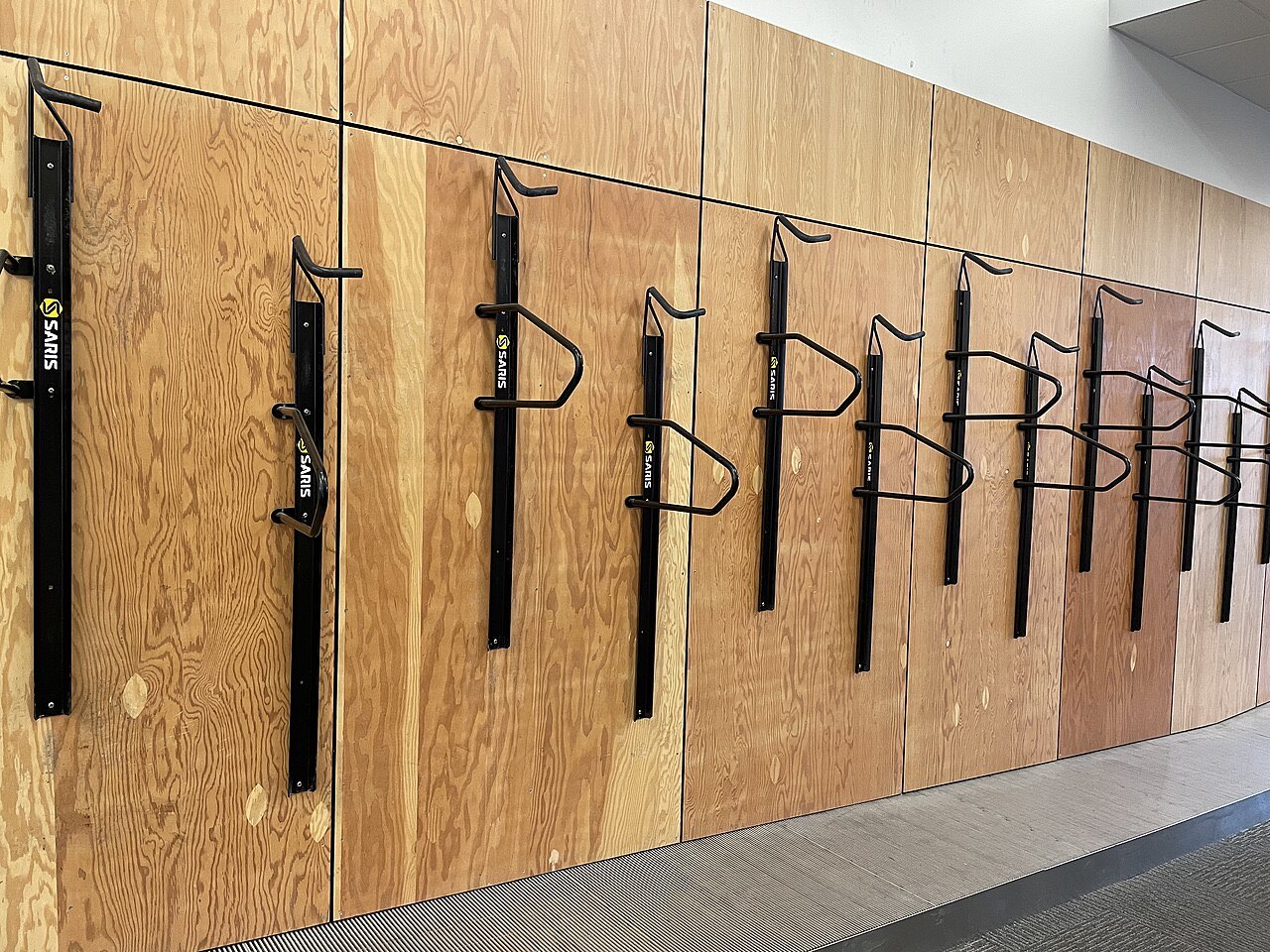
Fixed hooks (Delta Leonardo, generic rubber-coated hooks) are the cheapest and simplest. The bike hangs straight out from the wall, perpendicular to it, so a 70-inch bike sticks about 70 inches into the garage. That is fine along a side wall with no car next to it, and a problem in a one-car garage.
Hinged hooks (Feedback Sports Velo Hinge) add a pivot so the hanging bike swings toward the wall when not in use, reducing how far it projects.
Pivoting wheel cradles (Steadyrack) hold the front wheel in a cradle that pivots sideways, so bikes can swing toward the wall and overlap one another. They cost more but let you fit more bikes in less depth. The trade-off is stricter fit limits: the Classic takes tires only up to 2.1 inches and no fenders, which rules out many mountain bikes and commuter bikes, so check before you buy.
A loading tip that applies to any vertical rack: lifting the front wheel to hook height is the hardest part. Rolling the bike up on its rear wheel and guiding the front wheel into a cradle at about chest height is easier than lifting it to a hook above your head; Steadyrack’s Classic includes a rear tire rest for the wheel that stays near the wall.
E-bikes: check weight before anything else
E-bikes are the most common mismatch. Many weigh well over 50 lb with the battery fitted; check your bike’s published weight or weigh it (hold it on a bathroom scale and subtract your own weight).
Under 40 lb: almost any hook rated for the tire width works.
40 to 50 lb: a 50 lb-rated hook such as the Velo Hinge is at its limit; leave margin.
50 to 77 lb: a rack rated for the weight, such as Steadyrack’s eBike Rack (35 kg / 77 lb, 2.1 to 2.8 in tires).
Over 77 lb, or fat tires over 2.8 in: consider a floor stand, a wall-mounted horizontal rack rated for the weight, or a ceiling hoist rated for it. Lifting a heavy e-bike vertically onto any wall rack is hard work regardless of the rating.
Removing the battery before hanging reduces the weight and is easier on your back. Check your e-bike’s manual for any advice on storage orientation and battery storage (temperature, charge level); that is the maker’s call, not the rack’s.
Mounting: studs, block and drywall
Wood studs. Find the stud center with a stud finder and confirm with a small nail. Most residential walls are framed at 16 or 24 inches on center (City of Blaine framing handout), which matters for spacing below.
Drywall only: do not. Steadyrack says it does not recommend installing into drywall and that doing so voids its warranty, and Feedback Sports rates the Velo Hinge’s 50 lb when properly stud mounted.
Concrete or block. Steadyrack’s installation kit includes fixings for masonry and timber. In hollow block, use anchors with published hollow-block values; our guide to mounting on concrete block walls explains why hollow block holds less.
The stud-spacing problem. If studs are 16 inches apart and you want racks 14 inches apart, they will not all land on studs. Screw a horizontal 2x6 or a plywood backer across the studs (two screws per stud) and mount the racks to it anywhere along its length.
Spacing: how many bikes fit on your wall
Steadyrack’s wall placement guide is the most detailed published spacing advice:
Layout
Spacing between racks
Notes
Same height, no overlap
About 600 mm (24 in) per rack
Based on bars up to 600 mm wide
Staggered heights
As close as 350 mm (about 14 in)
Bars overlap neighbors; pivot for access
Staggered, flat handlebars
At least 400 mm (about 16 in)
Wider bars clash otherwise
Mixed bars
350 mm if you alternate narrow and flat bars
It also recommends hanging heavier and longer bikes on the lower racks and lighter bikes higher, and notes that staggered layouts push bikes further into the room and make the high racks harder to load. Spacing much wider (around 4 feet) lets bikes pivot flat against the wall without overlapping, which saves the most floor depth.
Worked example (our arithmetic): a 10-foot (120-inch) wall, staggered at 14 inches, fits about eight road bikes; with flat-bar bikes at 16 inches, about seven; same-height at 24 inches, five.
Vertical height: the hanging wheel’s hook goes at roughly the bike’s length above the floor plus a few inches, so the rear wheel clears the floor or sits on a tire rest. Measure your longest bike before you drill.
Where it fits in the garage
Wall racks belong where you walk out with the bike: near the garage door or the side door, on a wall clear of car doors. Keep them out of the path of the garage door and away from where a car’s mirror passes. If you also need shelving on that wall, see wall-mounted garage shelves for depth planning, and garage storage ideas by zone for layout.
Bikes you ride a few times a year are better overhead. Our planned guide to ceiling storage for bikes and kayaks covers hoists and ceiling hooks, and sports equipment storage covers the rest of the gear.
A buying shortlist
Road and hybrid bikes, no fenders, tight space: a pivoting cradle such as the Steadyrack road bike rack ($86.99) (the Amazon listing describes it as fitting narrow tires; the manufacturer gives 2.1 inches maximum and 77 lb).
Price as of November 18, 2026, 4:08 PM ET. Prices and availability are accurate as of the date/time indicated and are subject to change. Any price and availability information displayed on Amazon.com at the time of purchase will apply to the purchase of this product.
E-bikes with 2.1 to 2.8-inch tires: the Steadyrack eBike Rack, rated 77 lb.
Mountain bikes on a budget, under 50 lb: a hinged hook such as the Feedback Sports Velo Hinge, with the long hook for tires over its standard hook’s limit.
Light bikes, lowest cost: a fixed hook such as the Delta Leonardo, rated 40 lb.
Fenders: a fender-compatible model (Steadyrack’s Classic Fender is rated 55 lb) or a hook.
Check the current price on Amazon or at a bike shop, and confirm the tire-width limit for the exact version before ordering.
Mistakes to avoid
Ignoring tire width. A 2.4-inch MTB tire will not go into a 2.1-inch cradle.
Hanging an e-bike on a 40 lb hook.
Mounting into drywall or into a single stud edge.
Spacing for the bars you have now, not the flat-bar bike you buy next year. Leave a little extra.
Hanging too high. If you have to lift the bike overhead, you will stop using the rack.
Bottom line
Weigh the bike, read the tire size, and check for fenders. Then pick a rack rated above all three, mount it into studs or a backer board, and space racks 14 to 24 inches apart depending on your bars and whether you stagger them. Hooks for light bikes on a long wall, pivoting cradles for tight garages, and an e-bike-rated rack or a floor stand for anything heavy.
Frequently asked questions
How far apart should wall bike racks be?
It depends on handlebar width and whether you stagger heights. Steadyrack's wall placement guide gives about 350 mm (14 in) between racks when heights are staggered, at least 400 mm for flat handlebars, and roughly 600 mm (about 24 in) per rack when all racks are at the same height. Its older imperial brochure gives 24 in same-height and 12 in staggered.
Can a wall rack hold an e-bike?
Only if the rack's weight and tire limits cover it. Steadyrack's eBike Rack is rated to 35 kg (77 lb) with 2.1 to 2.8 in tires; a simple hook such as the Delta Leonardo is listed at 40 lb and the Feedback Sports Velo Hinge at 50 lb when stud mounted. Weigh your e-bike, check the manual about hanging it and removing the battery, and mount into studs.
Do I need studs to mount a bike rack?
Yes on a framed wall. Steadyrack says it does not recommend installing its racks into drywall and that doing so voids the warranty, and Feedback Sports rates the Velo Hinge's 50 lb only when properly stud mounted. On concrete or block, use masonry anchors rated for that wall.
Is hanging a bike by one wheel bad for the wheel?
The hook and rack makers design their products for this, and the rack's limits (tire width, bike weight, fender clearance) are what to respect. Hanging a bike that exceeds the weight rating, or forcing a tire wider than the hook into it, is where problems start. Hydraulic-brake and e-bike owners should check their bike's manual for any storage-orientation advice.
Are wall racks or ceiling racks better for a garage?
Wall racks are easier to load and unload every day and suit bikes you ride often. Ceiling racks and hoists free the wall and floor but are slower to use and need joists and lifting height, so they suit bikes stored for a season. Many garages use both.
Free garage storage tools
Tote and Shelf Fit CalculatorPick your storage tote and shelf size to see how many fit per shelf, which way to face them, the overhang and how many units you need.
How to assemble boltless rivet shelving the way the manuals say: keyholes narrow end down, beams ledge-up, seat every rivet, level, anchor, avoid mistakes.
Garage ladder storage compared: wall hooks for frequent use, ceiling racks for rare use, pulley hoists for high ceilings, with weights, ratings and mounting.