Ceiling Storage for Bikes and Kayaks: Hoists, Hooks and Capacity
In this guide
- Pick the right ceiling system
- Capacity: match the rating to the whole load
- Recalls: check older hoists
- Mounting: joists, not drywall
- Clearance: the door, the opener and the car
- Bikes: hooks, hoists or the wall?
- Kayaks and paddleboards: hoists and slings
- What not to hang from the ceiling
- No bonus-commission products fit this topic
- Quick checklist
Short answer: hang bikes you ride monthly or less and boats you use seasonally from the ceiling, and keep everyday bikes on the wall. Use simple joist hooks for bikes on ceilings you can reach, a pulley hoist for anything you cannot lift overhead or for ceilings above about 9 feet, and always compare the hoist’s rating with the full weight of what hangs from it. This is a spec-based guide built from manufacturer and retailer specifications, manuals and CPSC recall notices checked 2026-10-28; we have not installed these hoists ourselves. Disclosure: As an Amazon Associate I earn from qualifying purchases. See /disclosure/.
Pick the right ceiling system
| System | Best for | Typical published limit | Trade-off |
|---|---|---|---|
| Screw-in or bolt-on joist hooks | Bikes on ceilings you can reach from the floor | Varies by hook; often not stated | You lift the full bike overhead each time |
| Bike pulley hoist | One bike per hoist, ceilings up to the hoist’s limit | 100 lb per hoist (RAD Sportz, per retailer listings) | Slower; rope must be tied off correctly every time |
| Kayak / SUP pulley hoist | One boat per hoist on two straps | 150 lb per hoist (StoreYourBoard Essential, per maker) | Needs a clear drop zone under the boat |
| Ceiling trolley (Saris Cycle Glide) | Several bikes that slide along a track | 4 bikes, 50 lb each | Fixed track length; bike must still be lifted |
| Platform lift (Racor PHL-1R) | Bins and boxes, not long boats | 250 lb, 4 x 4 ft platform | Platform too short for most kayaks |
Figures are the makers’ or retailers’ published numbers, checked 2026-10-28. Ratings differ between versions of the same product, so the label on the box you receive governs.
Capacity: match the rating to the whole load
Every hoist and hook has a rated load. The load is not just the bike or boat: add straps, bags, a seat or anything left inside a kayak hatch. Three examples show how much ratings vary even within one brand:
- StoreYourBoard Essential kayak hoist: 150 lb per hoist, with versions for 8 to 10 foot and 10 to 14 foot ceilings and a flush mount that leaves about 4 to 6 inches above the boat, according to the maker’s product pages.
- StoreYourBoard Hi-Lift Pro (older model, outlet listing): rope rated to 60 lb and ceilings up to 12 feet. Same brand, very different number.
- RAD Sportz bicycle hoist: 100 lb per hoist and ceilings up to 12 feet, per retailer listings; we could not find the maker’s own manual online.
Use the published weight of your kayak or bike, or weigh it on a bathroom scale (step on holding it, subtract your own weight). Long touring kayaks and tandems weigh much more than short recreational boats, and e-bikes weigh far more than road bikes. If the item is close to the rating, choose a higher-rated product rather than relying on the margin.
Ratings assume a static load hanging straight down. Do not swing, bounce or climb on a hoisted load, and never stand under it while raising or lowering. The Garage Gator storage lift manual and SafeRacks manual both warn against standing under or hanging from overhead storage; the same logic applies to a rope hoist.
Recalls: check older hoists
In September 2020 the CPSC announced a recall of about 36,700 StoreYourBoard Hi-Lift Storage Hoists, Classic and Pro, because the green polypropylene straps could break and drop the load. The remedy was free black replacement straps. If you buy a used hoist or find one in a garage you have moved into, compare it with the recall notice first. Overhead racks have had recalls too; our motorized ceiling storage lift guide lists the FLEXIMOUNTS GL44B rack recall.
Mounting: joists, not drywall
Every ceiling system here hangs from the framing above the drywall. Find the joists with a stud finder, confirm them with a small pilot hole, and drive the hook or lag screws into the center of the joist. The overhead lift and rack manuals we read give the same baseline:
- Joist size and spacing: at least 2 x 6 joists, 24 inches or less apart (Garage Gator 68221 and SafeRacks manuals).
- Screw position: in the center of the joist, with at least 2 inches of thread in solid wood (Garage Gator manual).
- Trusses: Garage Gator accepts a 2 x 4 truss bottom chord for its lift; other makers do not address trusses. If your garage ceiling is trusses, has an attic floor or you are unsure what is above it, ask a builder before adding a boat overhead.
Joists usually run 16 or 24 inches apart on center (Blaine, MN framing basics). A kayak hoist has two pulley points that need to land on joists; if the joists run parallel to the boat, both points can go on one joist or on a 2 x 4 or 2 x 6 cleat lagged across several joists. Retailer listings for the RAD Sportz hoist describe this cleat approach. Our overhead rack install guide covers finding joists and pilot-hole sizes in more detail.
Clearance: the door, the opener and the car
A ceiling in a garage is not empty space. Before you choose a spot, map three things:
- The open door. A sectional door rolls up and back on tracks that run close to the ceiling; anything hanging in that zone hits the door.
- The opener rail. It runs down the center of each door bay, usually with a motor at the back.
- The vehicle roof. Measure from the floor to the lowest point of the hanging load, then subtract the height of your tallest vehicle, including roof bars or a cargo box.
Good spots are along the side walls beside the door tracks, over the hood area at the back wall, and over a workbench. A bike hanging vertically by one wheel drops its full length below the hook, so measure the bike end to end first; on an 8-foot ceiling a vertically hung adult bike usually belongs over a bench or the hood of a car, not over the roof. A pulley hoist that lifts the bike flat takes far less height. Our overhead rack and ceiling height guide has the door-track measurements in more detail.
Bikes: hooks, hoists or the wall?
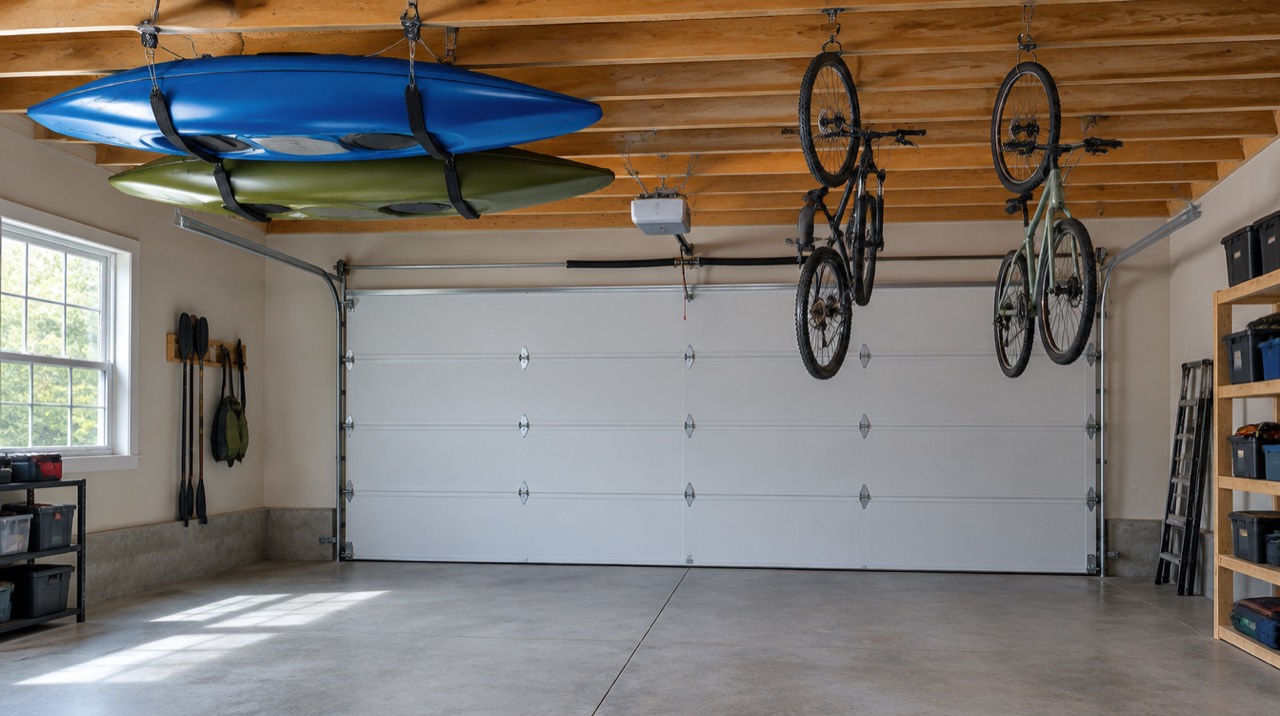
Hooks. Vinyl-coated ceiling hooks screwed into a joist hold a bike by one wheel. They are the cheapest option and work well when you can lift the bike to the ceiling safely. Space them at least one handlebar width apart, or stagger the bikes front and back.
Pulley hoists. A bike hoist has two hooks that catch the handlebars and saddle, and a rope that raises the bike flat against the ceiling. It suits ceilings above reach and bikes you store for a season. Tie off the rope exactly as the instructions show every time; the rope cleat is the only thing holding the load.
Trolleys. The Saris Cycle Glide is a ceiling track that holds four bikes up to 50 lb each and slides them along, with a 2.5-inch tire and 56-inch wheelbase limit, per a retailer spec page. You still lift each bike onto its hook.

Or the wall. If you ride every week, lifting a bike overhead gets old fast. A vertical wall rack, such as the Steadyrack road bike rack ($86.99) (77 lb maximum per the maker), is quicker. Our wall-mounted bike rack guide compares hooks and pivoting racks, including e-bike limits.
Price as of November 18, 2026, 4:08 PM ET. Prices and availability are accurate as of the date/time indicated and are subject to change. Any price and availability information displayed on Amazon.com at the time of purchase will apply to the purchase of this product.
Kayaks and paddleboards: hoists and slings
A kayak needs support at two points along the hull. Kayak hoists use two padded straps, one near each end, on separate pulleys that share one rope, so the boat rises level. Follow the hull maker’s guidance on where to place straps and which way up to store the boat; we did not find one rule that applies to every hull.
- One person, one boat: a single kayak hoist rated above the boat’s weight, mounted over a clear floor area so you can lower the boat straight onto a cart or the floor.
- Two boats: two hoists side by side, with enough space between them that the hulls do not touch while rising.
- Paddleboards: most kayak hoists also lift SUPs; confirm the board’s length fits between the straps.
- Long sea kayaks: check that the pulley points can be spaced far enough apart, and that the boat clears walls and the door track along its full length.
A kayak hoist needs a drop zone, so do not mount it above the parking space if the car must move every time you lower the boat. Over the back of a bay or over a side aisle is usually easier.
What not to hang from the ceiling
- Totes and heavy bins on a single hook. Use a rack rated for the load; see our overhead garage storage guide.
- Ladders on bike hooks. Use a ladder rack or pulley rated for the ladder; our ladder storage guide covers them.
- Anything over the parking spot that would hit the car if a rope slipped.
- E-bikes on basic hoists unless the rating covers the bike and the bike’s manual allows hanging it; remove the battery if the maker advises.
No bonus-commission products fit this topic


None of this site’s current bonus-commission brands makes ceiling bike or kayak hoists, so none is featured here. The hoists above are named from their makers’ published specs. For bins and seasonal totes overhead, a fixed rack is the better tool; FLEXIMOUNTS ($145.99) and MonsterRAX ($159.98) 4 x 8 racks are compared in our FLEXIMOUNTS vs MonsterRAX guide.
Price as of November 18, 2026, 4:08 PM ET. Prices and availability are accurate as of the date/time indicated and are subject to change. Any price and availability information displayed on Amazon.com at the time of purchase will apply to the purchase of this product.
Quick checklist
- Weigh the bike or boat; add straps and accessories.
- Pick a hoist or hook rated above that total, for your ceiling height.
- Check older hoists against the CPSC recall list.
- Find joists; screw into their centers, never into drywall alone.
- Map the door track, opener rail and vehicle roof; hang beside or behind them.
- Leave a clear drop zone under every hoist.
- Tie off the rope correctly every time and never stand under a moving load.
Frequently asked questions
How much weight can a ceiling bike hoist hold?
It depends on the model, so read the rating on the box or manual. Retailer listings for the RAD Sportz bike hoist give 100 lb per hoist, and StoreYourBoard lists its Essential kayak hoist at 150 lb per hoist, while its older Hi-Lift Pro outlet listing gives 60 lb. Compare the rating with the weight of what you hang, including straps and any accessories.
Can I hang a kayak from garage ceiling joists?
Usually yes, if the hoist or hooks are screwed into the center of solid wood joists, not drywall alone. Garage lift and rack manuals such as Garage Gator's and SafeRacks' call for at least 2 x 6 joists spaced 24 inches or less apart. If your ceiling is trusses, an unknown framing type or carries attic storage, have a builder confirm it before adding a boat overhead.
Is a pulley hoist or simple hooks better for bikes?
Hooks are cheaper and faster if you can lift the bike overhead safely, which works on ceilings around 8 feet. A pulley hoist lets you raise a bike or boat you cannot lift by hand and suits ceilings up to the hoist's stated limit, often about 12 feet for basic bike hoists. For several bikes used weekly, a wall rack is usually quicker than either.
Will a kayak on the ceiling hit my garage door?
It can. A raised sectional door rolls back along tracks near the ceiling, and the opener rail runs down the middle. Hang boats and bikes beside the door path or above the area behind the open door, and measure the lowest point of the hanging load against the open door and your vehicle roof before choosing a spot.
Were StoreYourBoard hoists recalled?
Yes. In September 2020 the CPSC announced a recall of StoreYourBoard Hi-Lift Storage Hoist Classic and Pro units because their green polypropylene straps could break; the remedy was free black replacement straps. If you own an older Hi-Lift with green straps, check the recall notice before using it.
Keep planning
- 4x8 vs 3x8 Overhead Garage Rack: Which Fits
4x8 vs 3x8 overhead garage rack: how to choose by ceiling height, garage door and opener clearance, joist spacing, tote count and published capacity.
Updated Oct 2026 - Storing Holiday Decor in the Garage: Racks, Totes and Tree Bags
How to store holiday decor in the garage: what goes overhead vs on shelves, tote and rack fit, tree bags, lights, and what never belongs in a hot garage.
Updated Oct 2026 - Motorized Ceiling Storage Lifts: Capacity, Power and Safety
How motorized garage ceiling storage lifts compare on capacity, travel, duty cycle, power and joist mounting, plus the recalls and checks that matter.
Updated Oct 2026