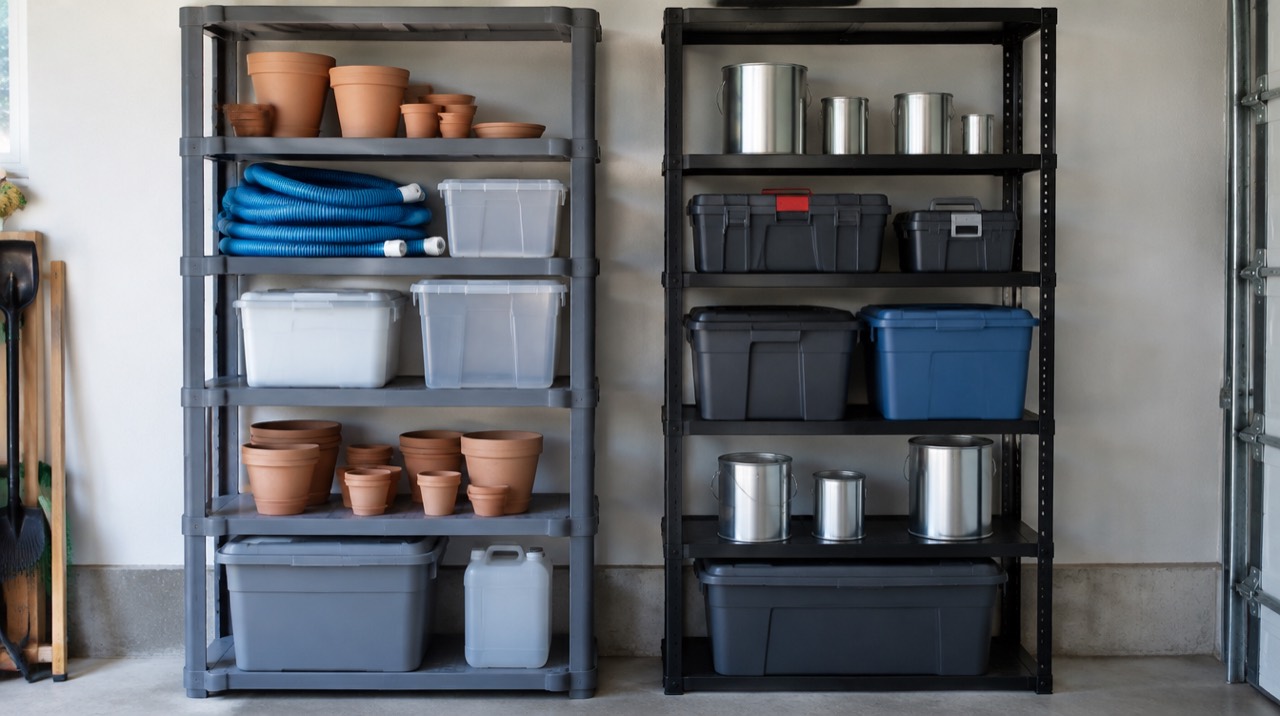
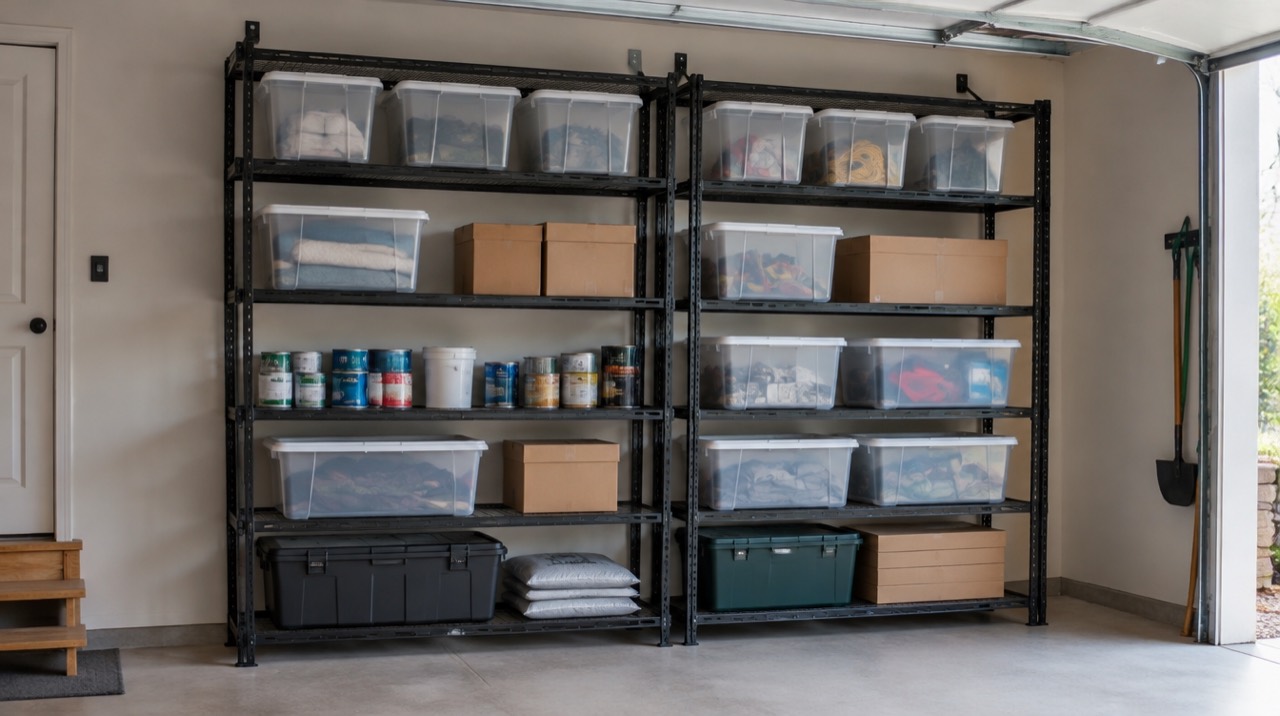
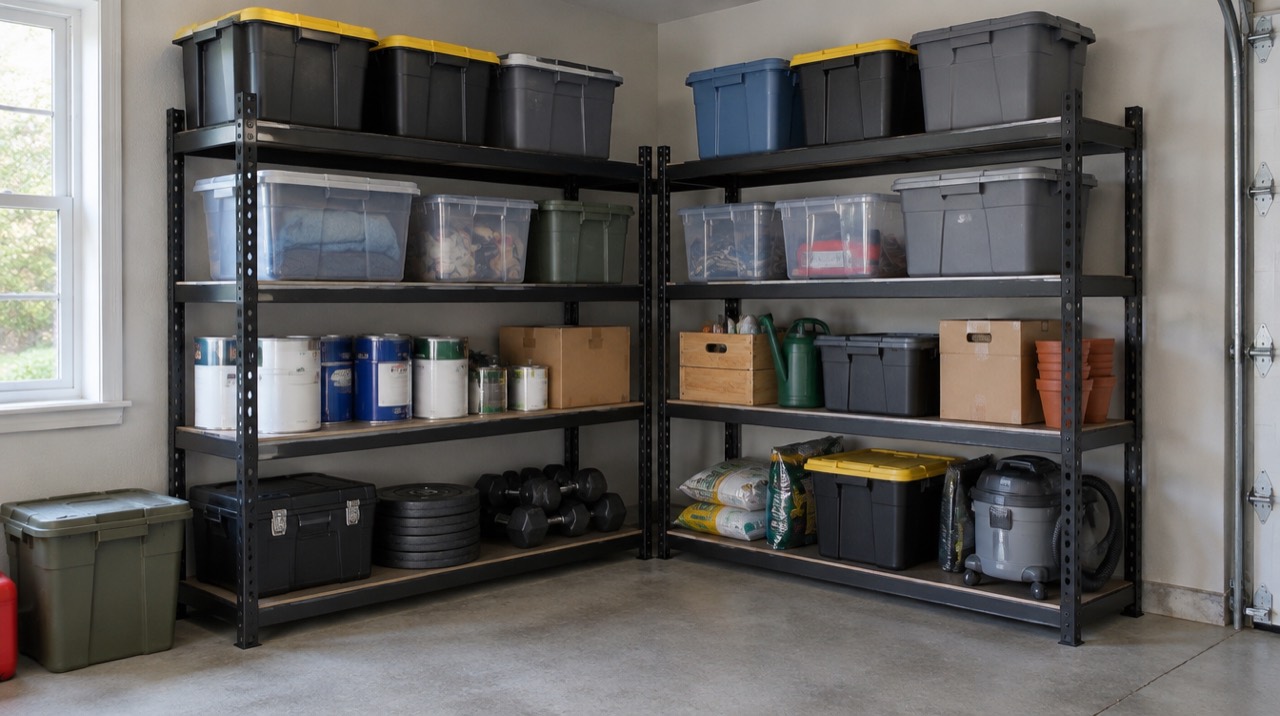
Renter-Friendly Garage Storage: No-Drill Shelving That Stays Put
In this guide
If you rent, the garage storage that works is the storage you can carry out: freestanding steel shelving, rolling carts and good totes. The catch is that tall, loaded shelving can tip, and the usual fix is a screw into a wall stud. So choose units that are hard to tip without help: a deep base relative to the height, the heaviest loads on the bottom shelves, a level stance on the slab, and nobody climbing them. If the unit is tall or children use the garage, ask your landlord for one or two screws into a stud; the CPSC says those holes patch in minutes. This is a spec-based guide: products are compared on their published listings, checked 2026-10-28, not tests of our own.
Disclosure: As an Amazon Associate I earn from qualifying purchases. Some brands featured below pay a bonus commission through Amazon Creator Connections. See /disclosure/.
What works without drilling, and what does not
| Storage type | Needs drilling? | Renter verdict |
|---|---|---|
| Freestanding steel shelving | No (anchor recommended) | Yes, chosen and loaded for stability |
| Rolling shelf carts | No | Yes, for light gear, casters locked |
| Stackable totes on the floor | No | Yes, against a wall, low stacks |
| Freestanding tool or bike stands | No | Yes |
| Track rails, slatwall, pegboard | Yes, into studs | Only with permission |
| Wall shelves | Yes, into studs or masonry | Only with permission |
| Overhead ceiling racks | Yes, lag bolts into joists | Usually no: large holes in the ceiling |
| Adhesive hooks | No | Light items only, not as a shelf anchor |
Why tall shelving tips, and what a renter can control
The CPSC estimates about 17,800 emergency-room-treated tip-over injuries a year from furniture, TVs and appliances (2020 to 2022 average), and its Anchor It campaign says to anchor all furniture with shelves. Shelving manuals say the same: Edsal’s tells owners to secure units to a wall. Without an anchor, four things decide how easily a loaded unit comes forward.
- Base depth relative to height. A deep, short unit is far harder to tip than a tall, shallow one. We compare the ratio below.
- Where the weight sits. Heavy items on the bottom two shelves lower the center of gravity; heavy items up top raise it. Edsal’s manual puts heavier items on the bottom.
- Level and stable footing. A unit leaning forward on a sloped floor is already partway to tipping.
- What people do to it. Climbing a shelf, pulling a stuck tote off a high shelf, or hanging on the frame adds a sudden forward pull.
The ratio that matters: height to depth
On our arithmetic, here is how common renter-friendly candidates compare. Lower is harder to tip. This is general statics, not a rating the makers publish.
| Unit (W x D x H) | Height / depth | Notes |
|---|---|---|
| Lionhon 4-tier, 59 x 23 x 67 in | 2.9 | Wide, short, heavy-duty |
| REIBII 5-tier, 48.2 x 24.5 x 72 in | 2.9 | Deep enough for 27-gal totes |
| REIBII wire mesh, 40 x 19.5 x 59.5 in | 3.1 | Short; splits into two |
| REIBII 4-tier wire, 68.3 x 23.4 x 72 in | 3.1 | Ships with two anti-tip kits |
| REIBII rolling, 31.5 x 16.5 x 59.8 in | 3.6 | Casters raise and shift the base |
| Lionhon 4-tier, 36 x 16 x 71 in | 4.4 | Tall and shallow: anchor it or skip it |
A rule of thumb from these numbers: for a no-drill garage, favour units around 3 or lower, and if you only have room for a tall, shallow unit, that is the one to ask permission to anchor.
Picks for renters

Check the current price of the Lionhon 4-tier heavy-duty shelving on Amazon.
$125.99Price as of November 18, 2026, 4:08 PM ET. Prices and availability are accurate as of the date/time indicated and are subject to change. Any price and availability information displayed on Amazon.com at the time of purchase will apply to the purchase of this product.

Check the current price of the REIBII 40-inch wire mesh shelving on Amazon.
$99.96Price as of November 18, 2026, 4:08 PM ET. Prices and availability are accurate as of the date/time indicated and are subject to change. Any price and availability information displayed on Amazon.com at the time of purchase will apply to the purchase of this product.

Check the current price of the REIBII 48.2-inch 5-tier shelving on Amazon.
$175.98Price as of November 18, 2026, 4:08 PM ET. Prices and availability are accurate as of the date/time indicated and are subject to change. Any price and availability information displayed on Amazon.com at the time of purchase will apply to the purchase of this product.

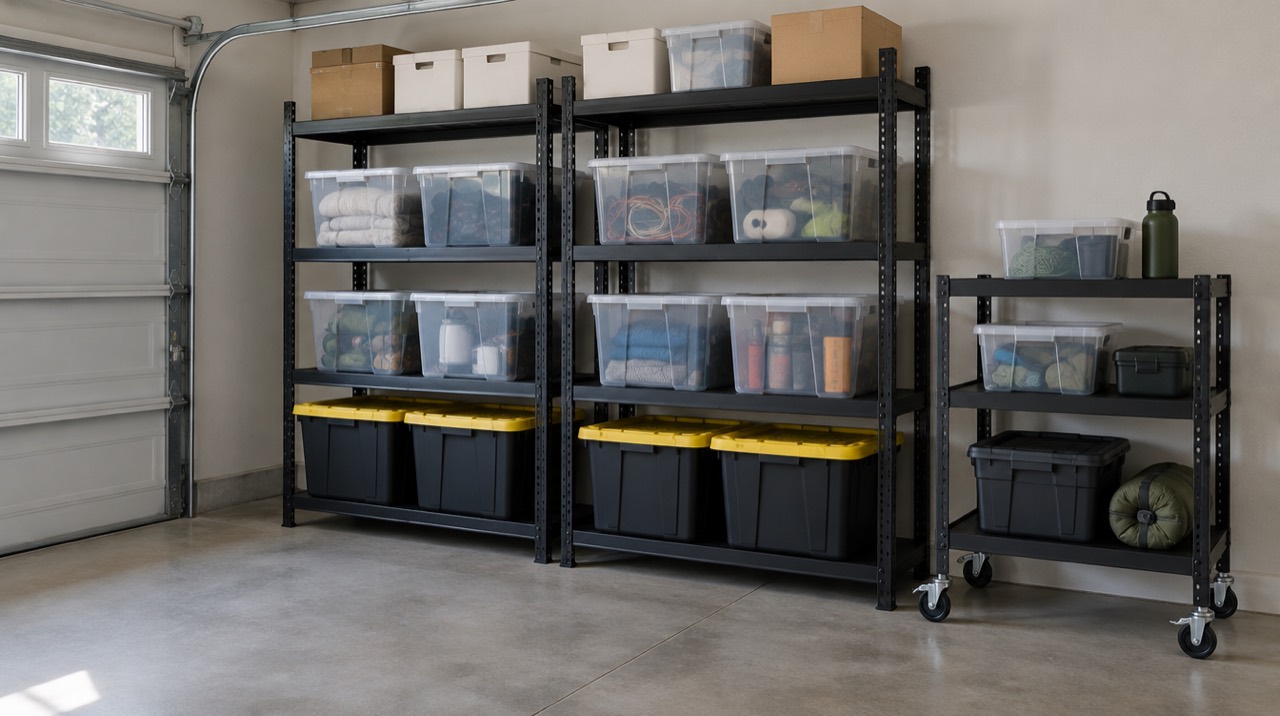
For moving things around: the REIBII rolling 4-tier unit ($79.99) (Featured, disclosed relationship) uses 2-inch rubber casters with locking latches or included steel feet. Its listing drops from 2,080 lb on feet to 530 lb on casters. On wheels it is a cart for light gear and cleaning supplies; lock the casters and keep heavy items on the bottom shelf. For heavy storage, fit the feet.
Price as of November 18, 2026, 4:08 PM ET. Prices and availability are accurate as of the date/time indicated and are subject to change. Any price and availability information displayed on Amazon.com at the time of purchase will apply to the purchase of this product.
Other units, including Edsal and Husky, are compared in best garage shelving, and the REIBII and Lionhon ranges are compared directly in REIBII vs Lionhon garage shelving.
Leveling on a sloped garage floor
Garage slabs are commonly built with a slope toward the door or a drain so water runs out. A shelving unit set on that slope leans, and a lean toward the room is the direction you least want.
- Check with a level on a middle shelf, front to back and side to side.
- Shim the low feet with hard plastic or composite shims under the foot plates, not soft wood that crushes. Shim so the unit leans very slightly toward the wall, never forward.
- Use the foot pads the maker supplies; they protect the slab and reduce sliding.
- Recheck after loading. Weight can settle a unit onto its shims.
- Keep a gap from the wall that you can close. Pushing the unit tight to the wall means a lean backward rests on the wall instead of into the room.
If your floor is badly uneven, our planned guide to garage shelving on uneven floors goes further.
Load it so it stays put
- Heaviest on the bottom two shelves: paint, tools, water, bagged salt.
- Lightest on top: holiday decorations, empty totes, paper goods.
- Nothing overhanging the front edge. Overhang moves weight forward.
- Keep the top shelf at or below eye level if you can, so nobody climbs.
- Use a step stool, never the shelf, to reach high.
- Spread the load across the width rather than one corner.
When to ask your landlord to anchor
Ask if the unit is taller than about 6 feet, has a height-to-depth ratio above about 3.5, holds heavy items, or children use the garage. The CPSC’s Anchor It site makes the case to landlords: it says covering anchor holes “won’t be a problem” when you move, and its repair tips show drywall holes filled with spackle and masonry holes filled with caulk or masonry filler. A CPSC staff report adds that small holes in drywall are easier to repair than large ones, so one screw into a stud is better than several large anchors.
Put the request in writing, offer to patch and paint when you leave, and keep the reply with your lease. Our anchoring guide shows the strap-and-bracket method on studs and block walls.
What does not work
Adhesive hooks as anchors. In a CPSC staff evaluation of anchors installed without tools, adhesive-backed plastic hooks withstood a 20-pound pull for several seconds; greater forces began to deform them, and the glue’s lifespan was not known. Staff saw them only as a temporary measure until a permanent anchor could go in. The same report notes that drywall cannot typically withstand a 50-pound pull straight out from the wall, which is why anti-tip kits ship with wood screws for studs.
Tension rods and leaning ladders. Nothing we found rates them for loaded garage shelving.
Overhead racks. They need lag bolts into joists and leave large holes in the ceiling; not a renter product unless the landlord installs it.
A renter’s starter setup
- One wide, short steel unit against the back wall for heavy items.
- One deeper unit for 27-gallon totes, loaded heavy at the bottom; see garage shelving depth for totes.
- A rolling cart with locking casters for cleaning supplies and garden gear.
- Clear, labelled totes stacked no more than two or three high on the floor.
Check the current price on Amazon for each, measure your walls first, and keep the car-door strip clear.
Frequently asked questions
How can I add garage storage without drilling?
Use freestanding steel shelving that is short and deep, load it heaviest at the bottom, level it on the slab, and add rolling carts for light gear. Skip wall rails, slatwall, wall shelves and ceiling racks: all of them need screws into studs or joists. If a unit is tall, or children are around, ask your landlord for permission to put one or two screws into a stud.
Do freestanding garage shelves need to be anchored?
Shelving manuals such as Edsal's say to secure units to the wall, and the CPSC's Anchor It campaign says to anchor all furniture with shelves. Without an anchor, you lower the risk by choosing a unit with a wide, deep base relative to its height, keeping heavy items low, never climbing it, and keeping it level.
Will my landlord let me anchor shelving?
Many will, because a small screw hole is easy to patch. The CPSC's Anchor It site says covering anchor holes is not a problem when you move, and its repair tips show how to fill drywall holes with spackle and masonry holes with filler or caulk. Ask in writing and check your lease before you drill.
Do adhesive hooks work to anchor shelving?
Not as a real restraint. In a CPSC staff evaluation, adhesive-backed plastic hooks held a 20-pound pull for several seconds before deforming at higher forces, and the glue's lifespan was unknown. Staff described adhesives as a possible stopgap until a permanent anchor can be installed. A loaded steel shelving unit can pull far harder than that.
What garage storage can I take with me when I move?
Freestanding steel shelving, rolling carts and stackable totes all move with you. Boltless units that split into two shorter racks, such as several REIBII models, also adapt to the next garage's walls. Wall systems and ceiling racks stay behind as holes to patch.
Keep planning
- Plastic vs Steel Garage Shelving
Plastic vs steel garage shelving compared on published load ratings, rust, moisture, depth and assembly, with spec-based steel picks from REIBII and Lionhon.
Updated Nov 2026 - Best Garage Shelving: Heavy-Duty Picks on Published Specs
Best garage shelving, compared on published specs: per-shelf load ratings, 18 vs 24 inch depth for totes, wire vs MDF decks, and which unit suits which garage.
Updated Oct 2026 - Corner Garage Shelving: L-Shaped Units and Corner Wall Shelves
Corner garage shelving: how to set two units in an L, how big the blind corner is, corner wall shelves, anchoring at the corner and which unit depths to pair.
Updated Oct 2026